
About the Author
KH is a practising solicitor based in London, admitted in England & Wales and regulated by the Solicitors Regulation Authority. He is registered with the Foreign, Commonwealth & Development Office. KH has worked as legal counsel and in-house solicitor across leading firms and corporations. He personally oversees every apostille and legalisation case at Ginkgo Advisory, ensuring consistency, accuracy, and end-to-end quality control.
KH Lam, LLB, LLM
Legal Consultant of Ginkgo Advisory
A Cayman Islands Apostille is required when Cayman Islands company documents are presented overseas for banking, investment, regulatory filings, or cross-border transactions. Without the correct Cayman Islands Apostille route, overseas authorities may reject documents even when they were validly issued in the Cayman Islands.
The Cayman Islands is a member of the Hague Apostille Convention, which allows documents to be recognised internationally through apostille certification. However, the correct Cayman Islands Apostille process still depends on where the document will be used. Therefore, understanding the correct route from the start helps avoid delays, rejection, and unnecessary cost.
This guide explains which Cayman Islands company documents usually require apostille, how the process works, and how requirements differ between Hague and non-Hague destination countries.
Corporate Documents Commonly Used Overseas
In practice, overseas banks, regulators, and counterparties often request apostilled copies of the following Cayman Islands corporate documents:
- Certificate of Incorporation
- Certificate of Good Standing
- Memorandum & Articles of Association
- Register of Directors
- Register of Members or Shareholders
- Incumbency Certificate
- Board Resolutions
- Share Certificates
- Powers of Attorney issued by a Cayman Islands company
These documents typically support overseas bank account opening, cross-border restructuring, investment approval, regulatory compliance, and legal proceedings.
Apostille Issuing Authority in the Cayman Islands
Who Issues Apostilles?
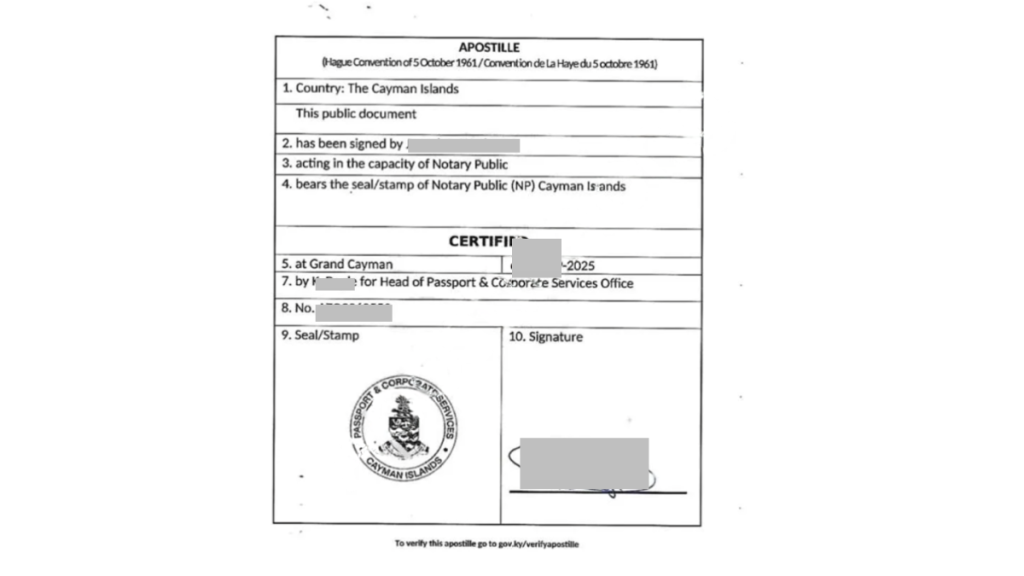
The Passport & Corporate Services Office (PCSO) issues apostilles in the Cayman Islands and acts as the official competent authority under the Hague Apostille Convention.
As a result, all apostilles are issued by a single recognised government authority, which improves consistency and acceptance by overseas banks, regulators, and public institutions.
Before apostille issuance, documents may still require certification by a Cayman Islands notary public or issuance as certified originals from the relevant registry. However, the PCSO always applies the apostille itself.
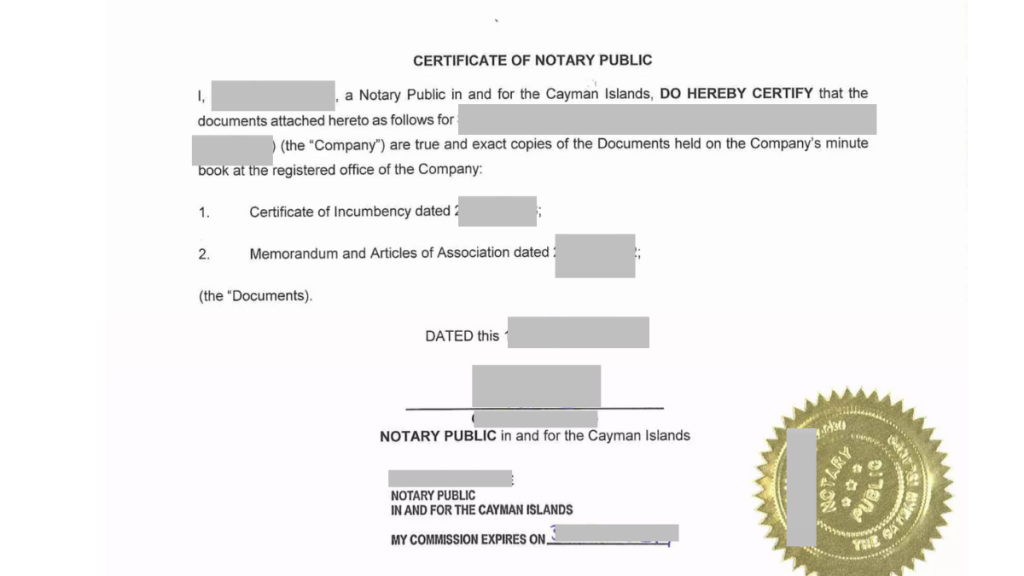
Overseas Use: Choosing the Correct Route
The correct legalisation route depends on whether the destination country is a member of the Hague Apostille Convention.
Use in Hague Convention Countries
Common destinations: China, Singapore, South Korea, Japan
For Hague Convention countries, the process ends once the apostille is issued.
Typical process:
- Complete Cayman Islands notary certification where required
- Obtain apostille from the Passport & Corporate Services Office
After completion, the document can be used directly in the destination country. Therefore, no UK Apostille, embassy legalisation, or Ministry of Foreign Affairs (MOFA) attestation is required.
Use in Non-Hague Countries
Common destinations: United Arab Emirates, Qatar, Vietnam, Thailand
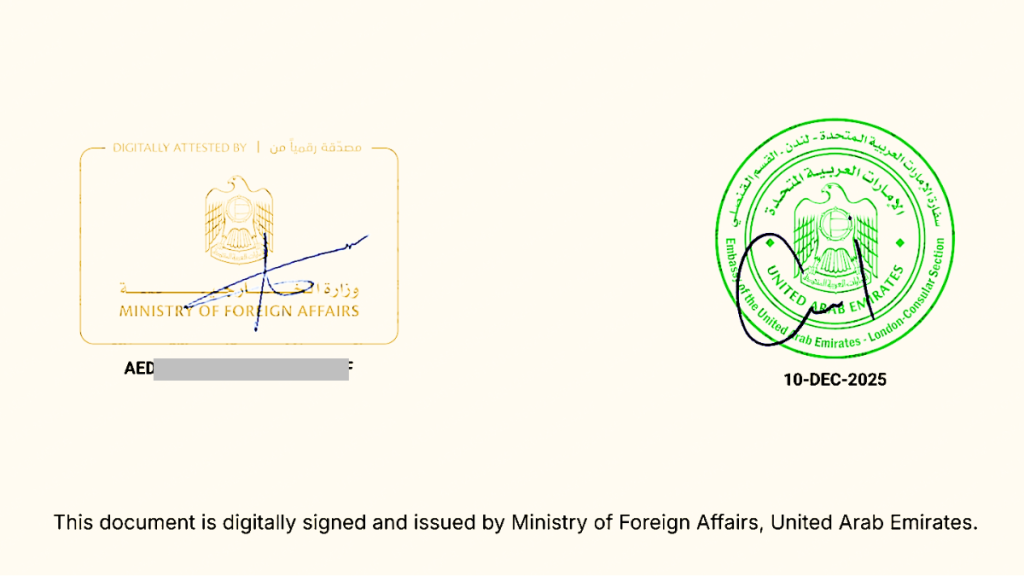
By contrast, non-Hague countries require full consular legalisation, even after apostille issuance.
Standard process:
- Cayman Islands notary certification
- Apostille issued by the Passport & Corporate Services Office
- UK Apostille through the Foreign, Commonwealth & Development Office (FCDO)
- Embassy legalisation in London
- Ministry of Foreign Affairs (MOFA) attestation in the destination country
Each step must follow the correct order. Otherwise, overseas authorities may reject the documents.
How Ginkgo Advisory Supports the Process
Apostille and legalisation for Cayman Islands documents often involve multiple authorities, jurisdictions, and international courier movements. In practice, errors in document sequencing or preparation frequently cause delays or rejection.
For this reason, Ginkgo Advisory provides end-to-end support, acting as a single point of coordination throughout the entire process.
Our services include:
- confirming the correct legalisation route based on destination country
- arranging Cayman Islands notary certification and apostille issuance
- managing UK Apostille services and embassy legalisation
- coordinating MOFA attestation for non-Hague countries
- handling secure international courier logistics
As a result, clients receive a fully compliant document set without managing multiple agents across different jurisdictions.
Summary: Selecting the Right Legalisation Path
| Destination Type | Example Countries | Final Step |
|---|---|---|
| Hague Convention | China, Singapore | Apostille |
| Non-Hague | UAE, Qatar | MOFA Attestation |
Choosing the correct Cayman Islands Apostille route from the start reduces risk, saves time, and avoids unnecessary cost.
If you are preparing Cayman Islands company documents for overseas use, Ginkgo Advisory can manage the full Cayman Islands Apostille process, from certification to final acceptance.
Contact Us



Address
Suite 161, 30 Red Lion Street, London, TW9 1RB, England