
About the Author
Kwok is a practising solicitor based in London, admitted in England & Wales and regulated by the Solicitors Regulation Authority. He is registered with the Foreign, Commonwealth & Development Office and admitted in Hong Kong (non-practising). Kwok has worked as legal counsel and in-house solicitor across leading firms and corporations. He personally oversees every apostille and legalisation case at Ginkgo Advisory, ensuring consistency, accuracy, and end-to-end quality control.
Kwok Lam
Legal Consultant of Ginkgo Advisory
A BVI Certificate of Incumbency Apostille is required when you use a British Virgin Islands Certificate of Incumbency outside the British Virgin Islands in a Hague Apostille Convention country.
In practice, banks, regulators, and professional firms expect formal international verification. Even when a company exists lawfully in the BVI, overseas authorities still require proof that the document is genuine.
Without the correct BVI apostille, authorities often reject the document.
For this reason, choosing the correct legalisation route at the outset matters.
This guide explains the process clearly and step by step, so your document works on first submission.
What Is a BVI Certificate of Incumbency?
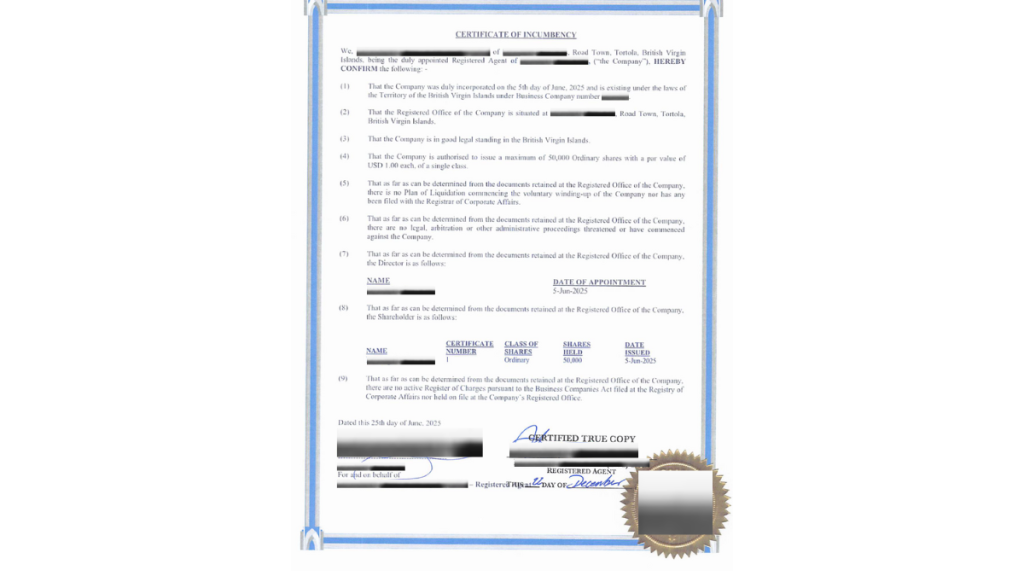
A Certificate of Incumbency is a formal corporate document linked to a company incorporated in the British Virgin Islands.
It confirms who currently has authority to act for the company. Most certificates list:
- company name and registration number
- registered office address
- current directors and officers
- authorised signatories
- shareholding or issued shares, where applicable
A Certificate of Incorporation proves existence.
By contrast, a Certificate of Incumbency proves authority.
Because of this difference, overseas institutions treat it as a high-risk compliance document.
When Do Authorities Request a Certificate of Incumbency?
Overseas authorities commonly request a Certificate of Incumbency for:
- corporate bank account opening
- KYC and AML checks
- investment onboarding
- cross-border transactions
- regulatory filings
- litigation or dispute resolution
Once the document leaves the British Virgin Islands, the receiving authority must confirm that it is authentic and officially verified.
As a result, apostille legalisation becomes necessary.
Why a BVI Certificate of Incumbency Needs an Apostille
Foreign authorities do not rely on scanned copies or informal confirmations.
Instead, they require a recognised international verification method.
For Hague Convention countries, that method is the apostille.
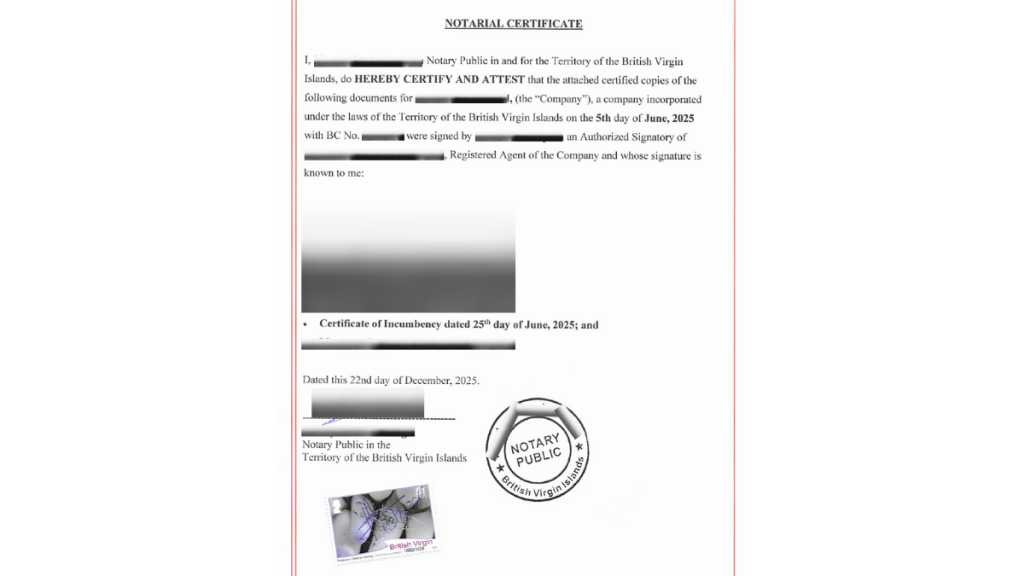
A BVI apostille confirms that:
- a recognised BVI authority or notary issued or certified the document
- the signature and seal are genuine
- the document remains unchanged
In short, company validity alone does not meet overseas standards.
Authorities must also verify corporate authority at an international level.
Who Issues Apostilles in the British Virgin Islands?
Only one office issues apostilles in the BVI:
The Office of the Deputy Governor of the British Virgin Islands
This office acts as the sole competent authority under the Hague Apostille Convention.
Because of this central structure:
- apostilles follow a standard international format
- overseas acceptance stays consistent
- further verification is unnecessary in Hague countries
Importantly, the apostille confirms signatures and seals only.
It does not assess business activity or financial position.
BVI Certificate of Incumbency Apostille Process
Hague Convention Countries
When the destination country belongs to the Hague Convention, the process is direct and final.
Step-by-Step Process
1. Prepare the certificate: First, obtain a current and properly issued Certificate of Incumbency.
2. Arrange BVI notary certification
3. Apply for the BVI apostille
After this step, the document is fully legalised for Hague countries.
Therefore, no embassy legalisation or MOFA attestation is required.
Countries That Accept a BVI Apostille
A BVI-apostilled Certificate of Incumbency can be used directly in all Hague Convention countries, including:
Asia-Pacific
China, India, Singapore, Japan, South Korea, Hong Kong SAR, Australia, New Zealand
Europe
United Kingdom, Ireland, Germany, France, Italy, Spain, Netherlands, Switzerland, Luxembourg
Americas
United States, Canada, Mexico, Brazil, Chile
Middle East
Israel
For these jurisdictions:
- a UK Apostille is not required
- embassy legalisation is not required
- MOFA attestation is not required
However, some authorities may still request a certified translation.
Important: Non-Hague Countries
This guide applies only to Hague Convention countries.
If the destination country does not belong to the Convention, the apostille route does not apply.
Common examples include:
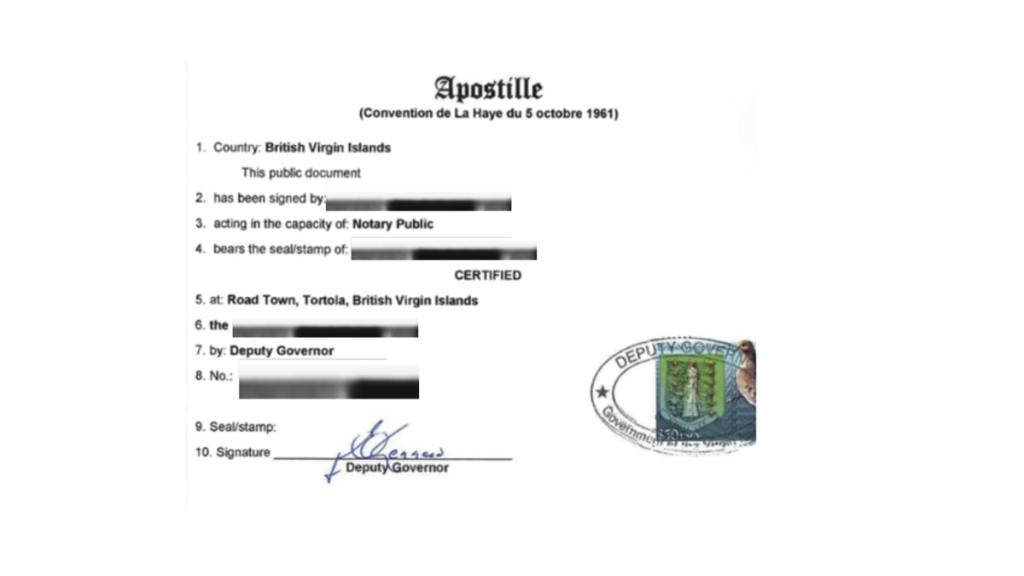
- United Arab Emirates (UAE)
- Qatar
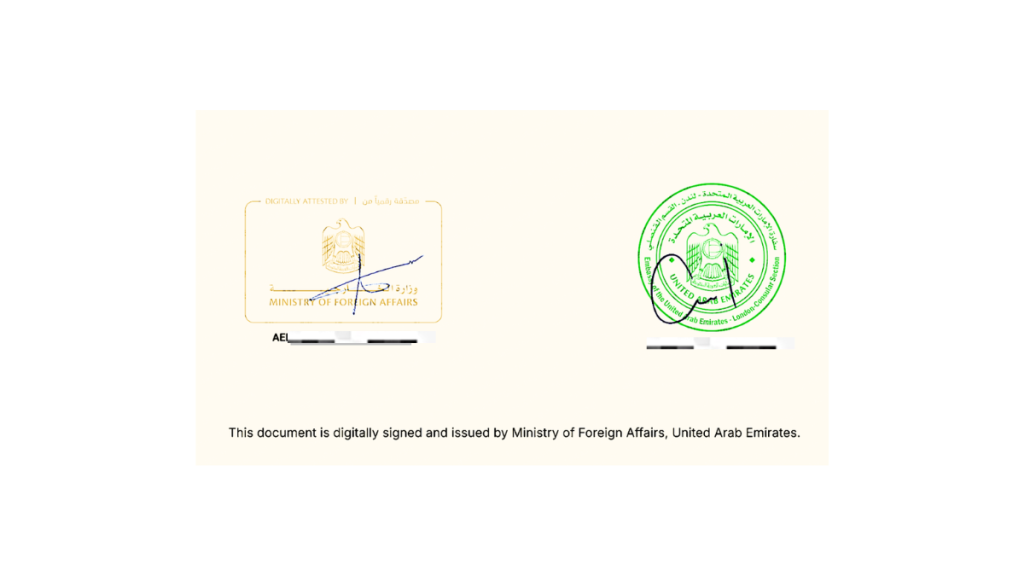
These jurisdictions require embassy legalisation and MOFA attestation, following a different sequence.
If the wrong route is used, rejection occurs immediately.
Therefore, confirming the destination country at the beginning is critical.
Common Reasons for Rejection
Most rejections happen because of process errors, not legal defects.
Common mistakes include:
- obtaining a UK Apostille instead of a BVI apostille
- assuming all countries accept apostilles
- skipping required BVI notary certification
- using an outdated Certificate of Incumbency
Fortunately, careful planning avoids all of these problems.
How Ginkgo Advisory Supports BVI Apostille Applications
Ginkgo Advisory manages the entire BVI Certificate of Incumbency apostille process.
Support typically includes:
- confirming whether an apostille is required
- checking the Hague status of the destination country
- arranging BVI notary certification when needed
- coordinating apostille issuance with the Deputy Governor’s Office
- managing secure international courier delivery
As a result, clients receive documents that banks and regulators can accept without delay.
Summary: BVI Certificate of Incumbency Apostille
| Destination type | Example countries | Required legalisation |
|---|---|---|
| Hague Convention | China, Singapore, India | BVI Apostille |
Choosing the correct BVI apostille route from the start prevents rejection, delay, and unnecessary cost.
If you plan to use a BVI Certificate of Incumbency overseas, proper apostille is not optional.
Instead, it is the standard requirement for acceptance.
Contact Us



Address
167-169 Great Portland Street, 5/F, London