
About the Author
KH is a practising solicitor based in London, admitted in England & Wales and regulated by the Solicitors Regulation Authority. He is registered with the Foreign, Commonwealth & Development Office. KH has worked as legal counsel and in-house solicitor across leading firms and corporations. He personally oversees every apostille and legalisation case at Ginkgo Advisory, ensuring consistency, accuracy, and end-to-end quality control.
KH Lam, LLB, LLM
Legal Consultant of Ginkgo Advisory
If you plan to work, live, study, or apply for a visa outside the United Kingdom, overseas authorities may require formal proof of your criminal record status. In most cases, this proof takes the form of a UK Disclosure and Barring Service (DBS) certificate that has been correctly certified, apostilled by the UK authorities, and, where required, further legalised by the relevant embassy.
This guide explains what a DBS certificate is, which type of DBS check is required, and how to prepare a DBS certificate correctly for international use. It focuses on process accuracy, sequencing, and common causes of rejection.
What Is a DBS Certificate?
A Disclosure and Barring Service (DBS) certificate is an official UK criminal record check. It confirms whether an individual has any recorded criminal convictions, cautions, warnings, or barring information.
Employers and authorities often require a DBS certificate for roles involving children, vulnerable adults, healthcare, education, or regulated professions. In addition, many overseas employers and immigration authorities request a DBS certificate as part of visa or work permit applications.
Outside the UK, authorities may describe a DBS certificate as a UK criminal record certificate or UK police clearance certificate. In most cases, the certificate must have been issued within the previous six months.
Types of DBS Checks
The UK issues four recognised levels of DBS checks. The correct level depends on the role and the destination country’s requirements.
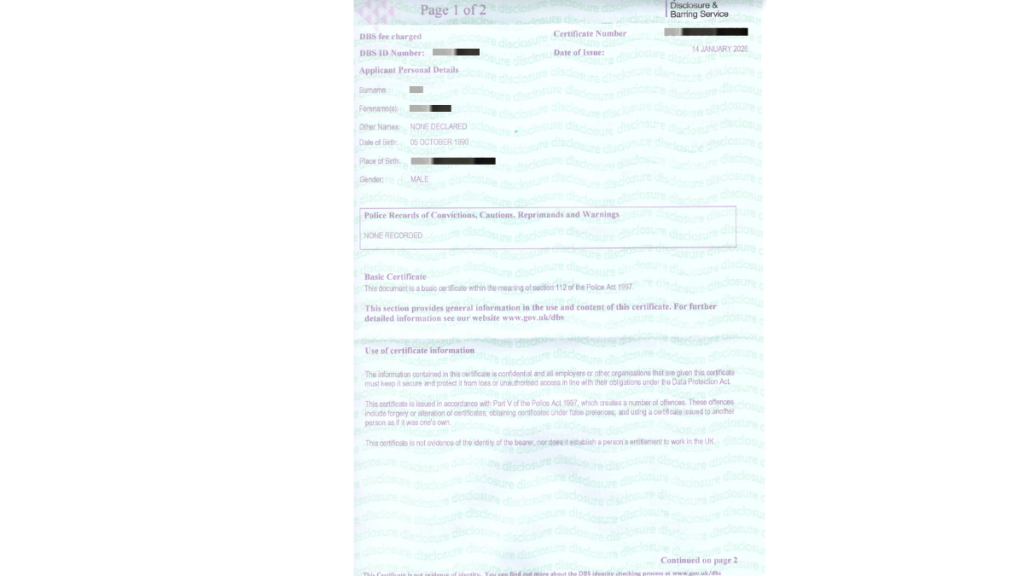
Basic DBS Check
A Basic DBS check shows unspent convictions only. Overseas employers and immigration authorities most commonly request this level.
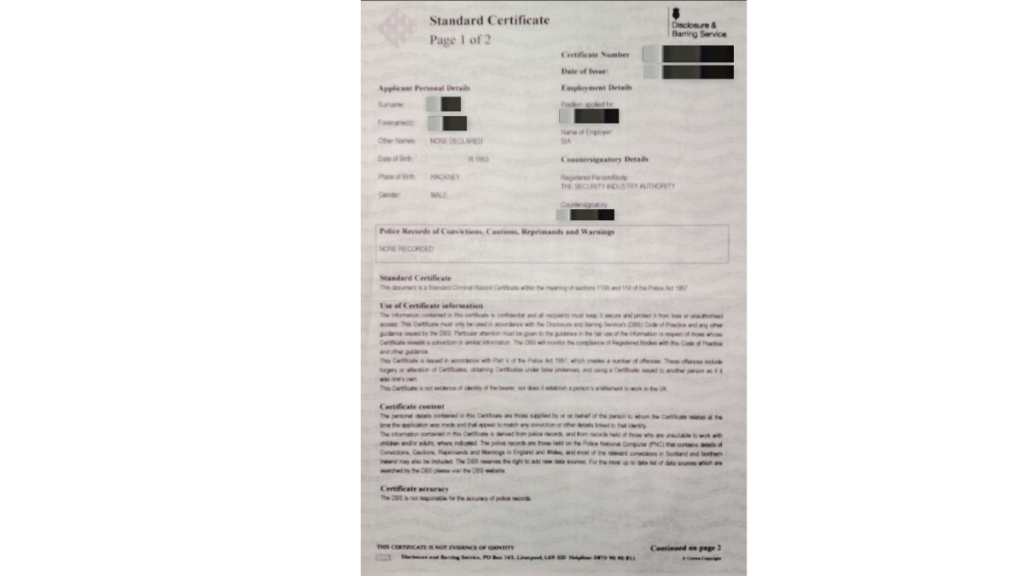
Standard DBS Check
A Standard DBS check shows spent and unspent convictions, as well as cautions, reprimands, and warnings. Certain regulated professions require this level.
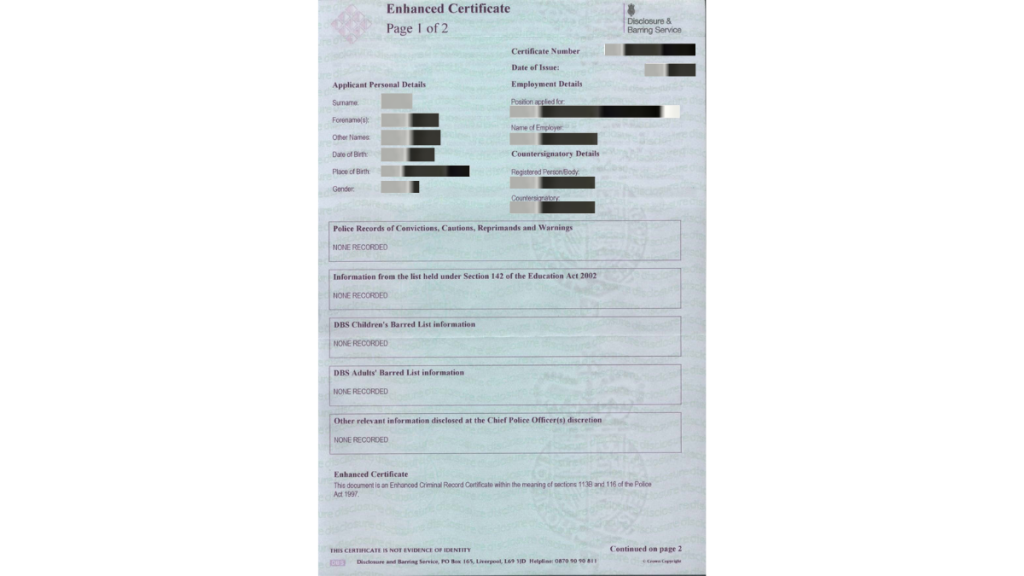
Enhanced DBS Check
An Enhanced DBS check includes the same information as a Standard check. In addition, it may include relevant information held by local police forces.
Enhanced DBS with Barred Lists
This level applies to individuals working directly with children or vulnerable adults. It also checks the relevant barred lists.
For international use, authorities usually request a Basic DBS check, unless they specify otherwise.
Why a DBS Certificate Requires an Apostille
A DBS certificate issued in the UK does not automatically have legal effect overseas. Foreign authorities must first confirm that the document and its certification are genuine.
An apostille is an official authentication certificate issued by the UK Foreign, Commonwealth & Development Office (FCDO). The apostille confirms that:
- the solicitor or notary who certified the DBS certificate is authorised, and
- the certification meets UK legal standards.
Once attached, the apostille allows the DBS certificate to be recognised by countries that are members of the Hague Apostille Convention.
Apostille and Embassy Legalisation Explained
The correct legalisation route depends on the destination country.
- Hague Convention countries require: solicitor certification or notarisation, followed by an FCDO apostille.
- Non-Hague countries require: solicitor certification or notarisation, an FCDO apostille, and then embassy legalisation or attestation.
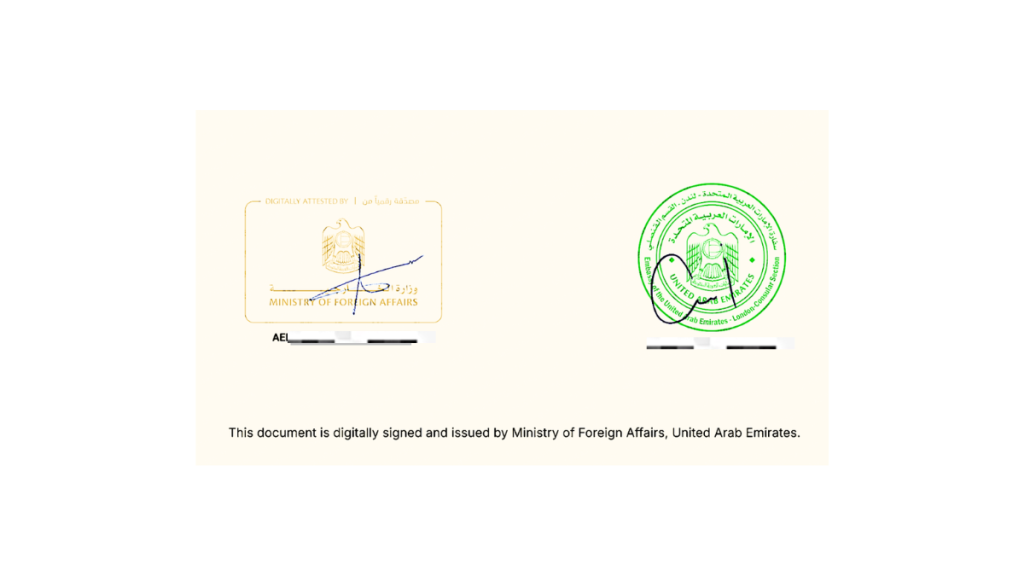
Countries that commonly require embassy legalisation include the United Arab Emirates, Qatar, Thailand, and Vietnam.
Importantly, authorities reject many DBS certificates because applicants follow the wrong sequence. Certification must always come before apostille.
What Is Required to Apostille a DBS Certificate
The DBS issues certificates as original physical documents. These certificates do not carry an official signature from the issuing authority. As a result, the document must be certified or notarised before the FCDO can issue an apostille.
To proceed, you must provide:
- the original DBS certificate, and
- solicitor certification or notarisation using acceptable wording.
If the wording is incorrect or incomplete, the FCDO may refuse to issue an apostille.
Step-by-Step Process to Legalise a DBS Certificate
Step 1 – Obtain the Correct DBS Check
You can apply for a DBS certificate in one of two ways:
- Apply directly for a Basic DBS check through the UK government system, or
- Apply through an employer or DBS umbrella body for a Basic, Standard, or Enhanced check.
Before applying, confirm which level the overseas authority requires. In addition, ensure the certificate will remain valid within the required time window.
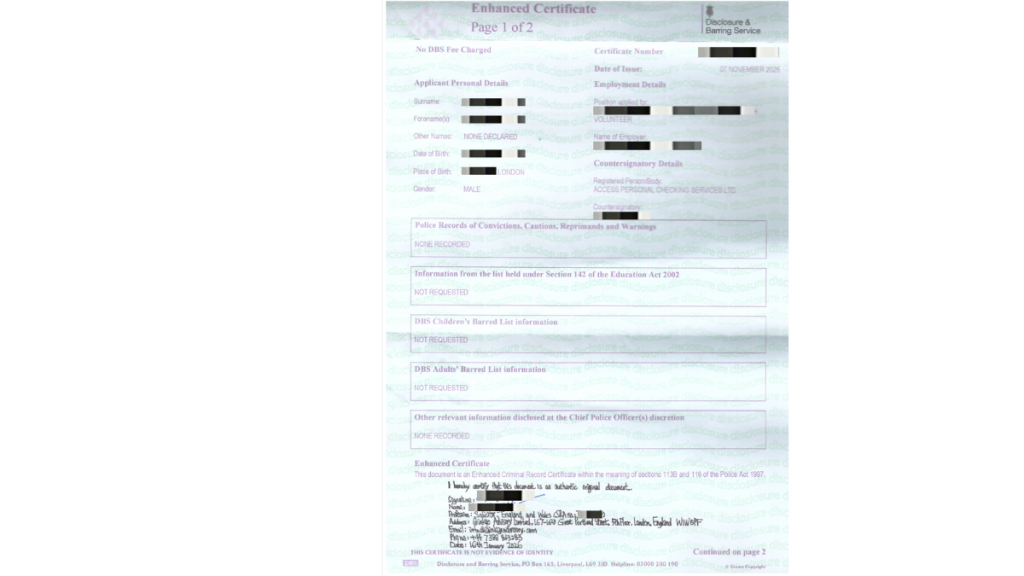
Step 2 – Solicitor Certification or Notarisation
Next, a solicitor or notary must certify the DBS certificate. This step is essential.
The certification wording must be precise and formal. Generic or informal wording often leads to rejection. For this reason, certification should always take place before apostille submission.
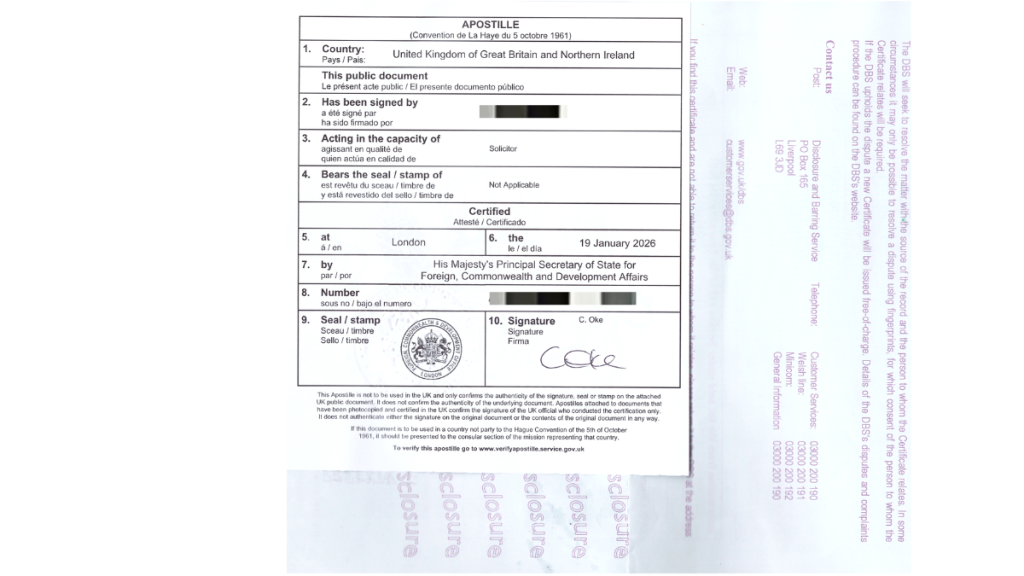
Step 3 – FCDO Apostille (UK Apostille)
After certification, the DBS certificate is submitted to the FCDO Legalisation Office. The FCDO then attaches the apostille.
Applicants can usually choose between:
- a standard service, which takes several working days, or
- a premium service, which may offer faster turnaround, subject to availability.
The apostille confirms the authenticity of the certification, not the content of the DBS itself.
Step 4 – Embassy Legalisation or Attestation (If Required)
If the destination country does not recognise apostilles, the document must then go to the relevant embassy or consulate. Each embassy applies its own rules, formats, and processing times.
Because embassy requirements vary, applicants should confirm destination-specific rules before submission.
Common Reasons DBS Certificates Are Rejected
Authorities most often reject DBS certificates for procedural reasons. Common issues include:
- incorrect or informal certification wording,
- apostille applied to an improperly certified document,
- the wrong DBS level for the intended use,
- certificates issued outside the permitted time frame, and
- missing embassy legalisation for non-Hague countries.
Careful preparation reduces these risks significantly.
How Ginkgo Advisory Assists
Ginkgo Advisory supports individuals and organisations preparing UK DBS certificates for overseas use.
Support includes:
- guidance on obtaining the correct DBS check,
- assessment of whether solicitor certification or notarisation is required,
- review of certification wording to ensure it meets FCDO and overseas authority standards,
- management of UK FCDO apostille submissions,
- advice on when embassy legalisation or attestation applies, and
- document review to reduce rejection risk caused by incorrect sequencing.
The aim is to ensure UK documents are prepared correctly before submission to overseas authorities.
Important Note
Always confirm final requirements with the relevant employer, embassy, or receiving authority before submission, as rules and practices may change.
Contact Us



Address
Suite 161, 30 Red Lion Street, London, TW9 1RB, England