Cayman Corporate Documents for International Banking, Investment and Regulatory Filings
The Cayman Islands Certificate of Incorporation is one of the most commonly requested corporate documents in cross-border transactions, offshore investment structuring, and international regulatory compliance.
When Cayman companies engage with foreign banks, regulators, investors, or transaction counterparties, they are frequently required to produce certified and apostilled corporate formation documents before onboarding, licensing, or funding processes can proceed.
A practical question therefore arises:
Can a Cayman Certificate of Incorporation be certified by a UK practising solicitor and apostilled by the UK Foreign, Commonwealth & Development Office (FCDO), instead of obtaining an apostille directly from the Cayman Islands?
In commercial practice, the UK certification and apostille route is widely used where transaction timing, cost efficiency, and document logistics are critical.
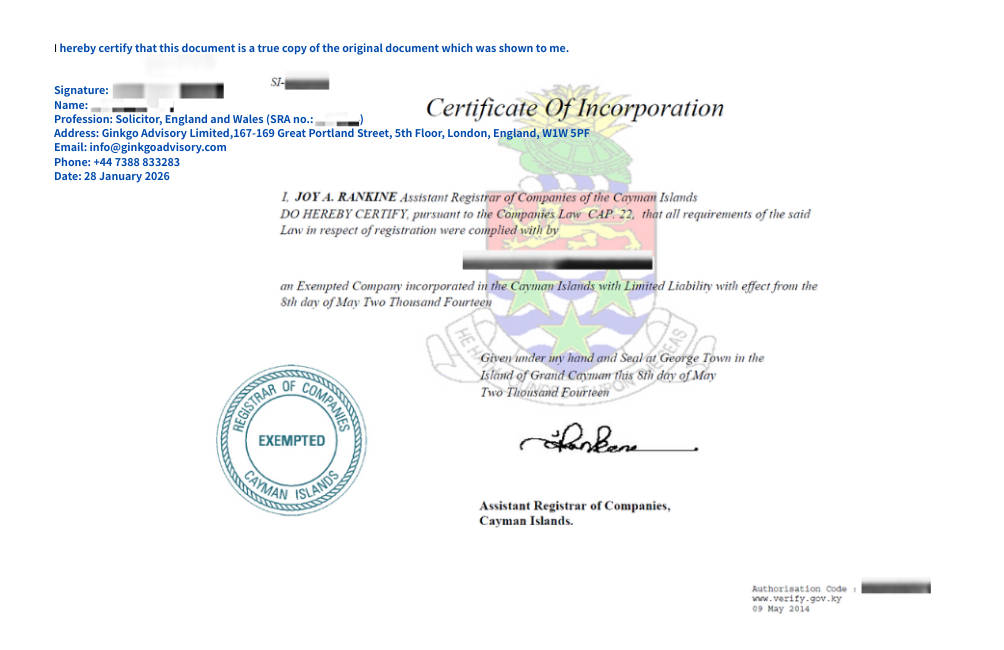
What Is a Cayman Certificate of Incorporation?
A Cayman Certificate of Incorporation is issued by the Cayman Islands Registrar of Companies and confirms the legal formation of a company under Cayman law.
The certificate typically verifies:
• Company registration and formation
• Incorporation date
• Registration number
• Confirmation of legal corporate existence
For most cross-border compliance checks, this certificate serves as the primary document evidencing that a Cayman entity is legally established.
Can Cayman Certificates Be Apostilled in the United Kingdom?
The Short Answer: Yes — Through Certification of a Copy
In many international compliance and transaction scenarios, a UK practising solicitor may certify a copy of a Cayman Certificate of Incorporation. The certified document can then be apostilled by the UK FCDO.
Importantly, this process does not authenticate the original Cayman registry document itself. Instead, it authenticates the UK solicitor’s certification.
This distinction is central to understanding how Hague Apostille Convention procedures operate across jurisdictions.
How the UK Certification and Apostille Route Works
The alternative UK apostille structure generally follows a three-stage compliance chain.
Step 1 — UK Solicitor Certification
A practising UK solicitor verifies and certifies a copy of the Cayman Certificate of Incorporation.
In some cases, the solicitor may certify a copy of a Cayman notarised corporate certificate rather than the registry document itself.
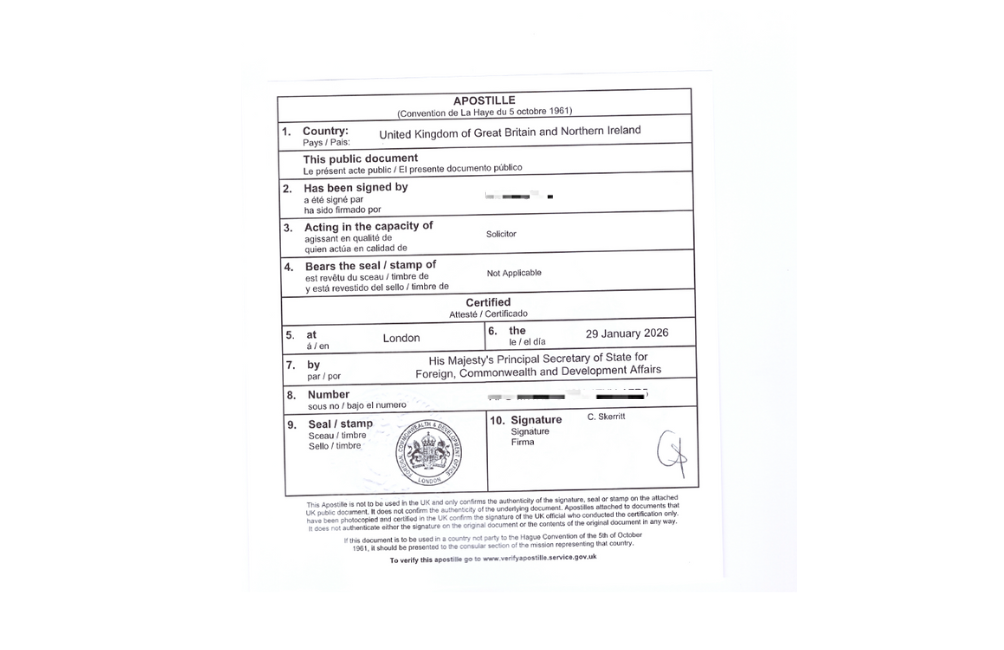
Step 2 — FCDO Apostille Issuance
The UK Foreign, Commonwealth & Development Office then issues an apostille confirming:
• The authenticity of the solicitor’s signature
• The solicitor’s regulated professional status
Step 3 — International Recognition
Under Hague Apostille Convention principles, foreign receiving authorities recognise the UK apostille as verification of the UK certification chain.
Why Companies Frequently Use the UK Apostille Route for Cayman Documents
Faster Processing Timelines
Obtaining solicitor certification and UK apostille often reduces turnaround time compared with offshore legalisation channels, particularly when documents are already located in the UK or Europe.
Reduced Cross-Border Courier Risk
Handling original Cayman registry documents internationally can introduce delays and evidential risks. Certification of copies reduces document handling exposure.
Commercial Transaction Efficiency
Corporate finance transactions, bank onboarding processes, and regulatory submissions frequently operate under strict timing requirements. The UK route often supports faster execution.
Common Use Cases for UK Apostille of Cayman Certificates
Receiving institutions often accept UK-certified Cayman incorporation documents in situations where professional certification is considered sufficient evidence of corporate existence.
Typical applications include:
• International banking onboarding and compliance reviews
• Shareholder verification and corporate authority checks
• Corporate financing and investment transactions
• Administrative or regulatory submissions accepting professional certification
Jurisdiction Acceptance Depends on Regulatory Purpose
Acceptance of UK-certified and apostilled Cayman corporate documents is not uniform across all countries or filing contexts.
Experience across cross-border transactions indicates that:
• Some regulators and administrative authorities accept UK certification chains
• Certain jurisdictions apply stricter registry-origin authentication requirements
• Acceptance may depend on the specific transaction, licensing regime, or evidential threshold
Ultimately, the receiving authority retains full discretion regarding document acceptance.
When Cayman Apostille May Still Be Required
Although the UK apostille route is commercially common, some regulatory or legal environments require authentication directly from the Cayman Islands.
Where evidential certainty becomes the primary objective, registry-origin apostille generally provides the strongest verification chain.
Compliance Considerations Before Choosing the UK Apostille Route
An UK apostille confirms the authenticity of the certifying professional’s authority. It does not guarantee acceptance by foreign regulators, banks, or counterparties.
Companies should evaluate:
• Destination country and regulatory framework
• Nature of the transaction or filing
• Required evidential standard
• Transaction timing and completion deadlines
A structured pre-filing review often prevents costly document rejection or duplication.
How Ginkgo Advisory Supports Cayman Corporate Apostille Workflows
Ginkgo Advisory provides transaction-focused certification and apostille coordination for offshore corporate documentation used in international compliance and investment transactions.
UK Solicitor Certification and FCDO Apostille Coordination
Our services include:
• Certified true copies of Cayman Certificates of Incorporation
• Certification of Cayman notarised corporate documents
• End-to-end FCDO apostille processing
• Translation and jurisdiction-specific submission preparation
• Transaction-driven document scheduling
This structure is particularly suitable for banking onboarding, corporate finance transactions, and time-sensitive cross-border compliance.
Cayman Apostille Coordination When Required
Where receiving authorities require registry-level authentication, Ginkgo Advisory also manages full Cayman legalisation processes, including:
• Cayman notarial certification
• Cayman Islands apostille processing
• International courier logistics
• Certified translation and filing preparation
Choosing the Correct Apostille Strategy for Cayman Companies
Every cross-border transaction carries its own regulatory, evidential, and timing considerations. Selecting the correct legalisation route requires balancing certainty, efficiency, and jurisdictional expectations.
Professional pre-transaction planning significantly reduces rejection risk and helps ensure documentation supports transaction completion without delay.
Ginkgo Advisory assists offshore companies, investors, and advisors in assessing document acceptance requirements and implementing the most efficient apostille strategy for each transaction.
Contact Us



Address
167-169 Great Portland Street, 5/F, London
 English
  Chinese