
About the Author
Kwok is a practising solicitor based in London, admitted in England & Wales and regulated by the Solicitors Regulation Authority. He is registered with the Foreign, Commonwealth & Development Office and admitted in Hong Kong (non-practising). Kwok has worked as legal counsel and in-house solicitor across leading firms and corporations. He personally oversees every apostille and legalisation case at Ginkgo Advisory, ensuring consistency, accuracy, and end-to-end quality control.
Kwok Lam
Legal Consultant of Ginkgo Advisory
This guide explains how to prepare Spanish public documents for use abroad.
In practice, the correct procedure depends on whether the destination country is a Hague Apostille Convention country or a non-Hague country.
For this reason, choosing the correct route from the start helps avoid rejection, delay, and repeated legalisation.
1. What Is an Apostille?
An apostille is an international certification created under the Hague Apostille Convention of 5 October 1961.
An apostille confirms three things:
- the authenticity of the signature,
- the legal capacity of the person who signed the document, and
- the validity of the seal or stamp.
As a result, a Spanish document with an apostille can be accepted directly in another Hague Convention country. Therefore, no embassy or consular legalisation is required.
2. Hague Apostille Convention Countries
(Apostille only – no embassy legalisation)
2.1 General Rule
If a Spanish public document will be used in a Hague Convention country, the process is simple.
First, Spain issues an apostille.
Then, the document becomes valid for use abroad without further legalisation.
2.2 Documents That Can Be Apostilled in Spain
Spain allows apostilles for the following public documents:
- Court documents
- Administrative documents
- Notarial documents
However, different authorities handle different document types.
2.3 Competent Authorities in Spain
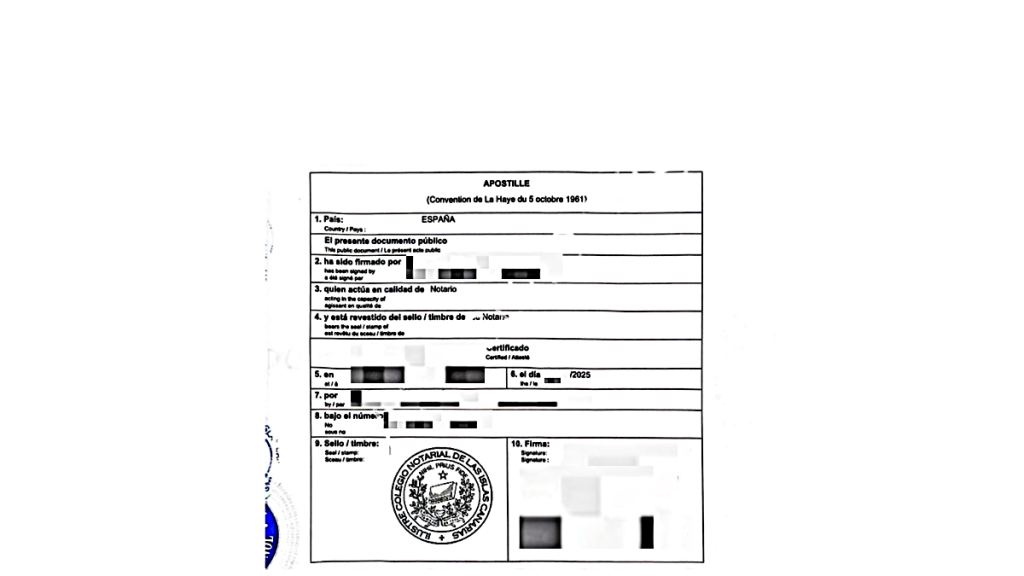
Notarial documents: The College of Notaries issues apostilles for notarial documents.
All other public documents: The Ministry of the Presidency, Justice and Relations with the Courts issues apostilles for all other public documents.
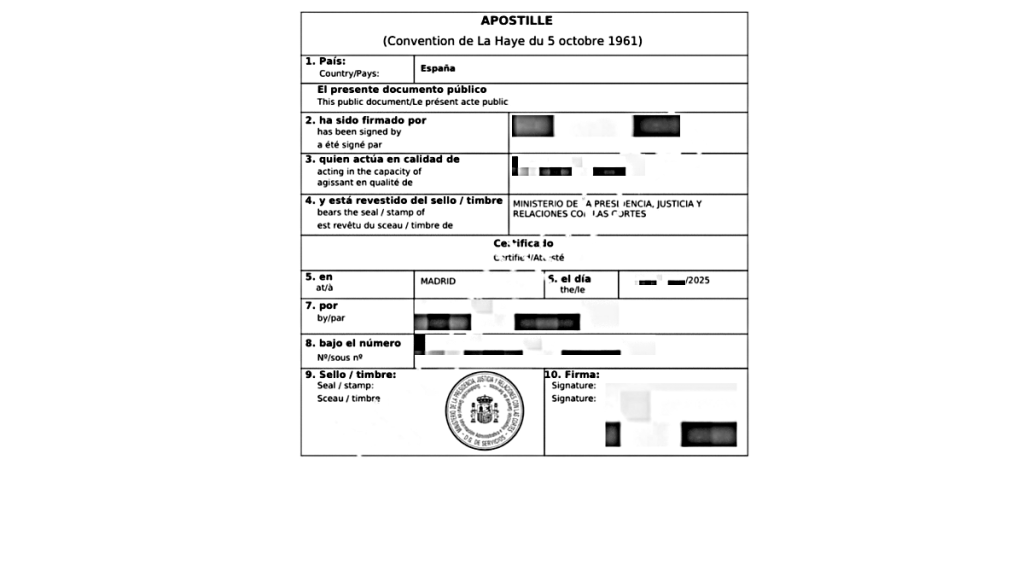
Once issued, the apostille allows the document to circulate freely among Hague Convention countries.
3. Non-Hague Apostille Convention Countries
(Full legalisation required)
If the destination country does not belong to the Hague Convention, an apostille alone is not enough.
Instead, Spanish documents must complete full diplomatic legalisation.
3.1 General Rule
For non-Hague destinations, Spanish public documents must pass through three clear stages:
- Pre-legalisation by the competent Spanish authority
- Legalisation by the Spanish Ministry of Foreign Affairs
- Legalisation by the embassy or consulate of the destination country
Each step confirms the validity of the previous one. Therefore, skipping any stage will usually result in rejection.
3.2 Pre-Legalisation Routes by Document Type
Because Spanish public documents come from different sources, the pre-legalisation route depends on the document type.
| Document Type | Pre-Legalisation Route |
|---|---|
| Administrative documents | Ministry responsible for the issuing body |
| Judicial documents (Civil Registry certificates, court decisions) | High Court of Justice (Autonomous Community) → Ministry of the Presidency, Justice and Relations with the Courts |
| Notarial documents (deeds, notarised statements) | Notary Association → Ministry of Justice |
| Academic documents – public education (university / higher education) | Ministry of Universities or Education Inspectorate |
| Academic documents – public education (non-higher education) | Regional Ministry of Education or Ministry of Education (Spanish centres abroad) |
| Academic documents – private education | Notarial recognition of signature → notarial route |
| Commercial documents | Provincial Chamber of Commerce → Higher Council of Chambers of Commerce |
| Registrars’ documents | College of Property and Commercial Registrars → Ministry of Justice |
| Medical certificates | Provincial College of Physicians → General Council of Physicians |
| Animal health certificates | Government Delegation or Subdelegation → Ministry of Agriculture |
| Bank documents | Bank of Spain |
| Religious documents (Catholic Church) | Diocese → Apostolic Nunciature |
| Religious documents (other religions) | Notarial signature recognition → notarial route |
| Documents from Autonomous Communities | Designated legalisation unit of the Autonomous Community |
| Local authority documents | Ministry of Territorial Policy and Democratic Memory |
| Spanish documents issued abroad | Foreign ministry of the issuing country |
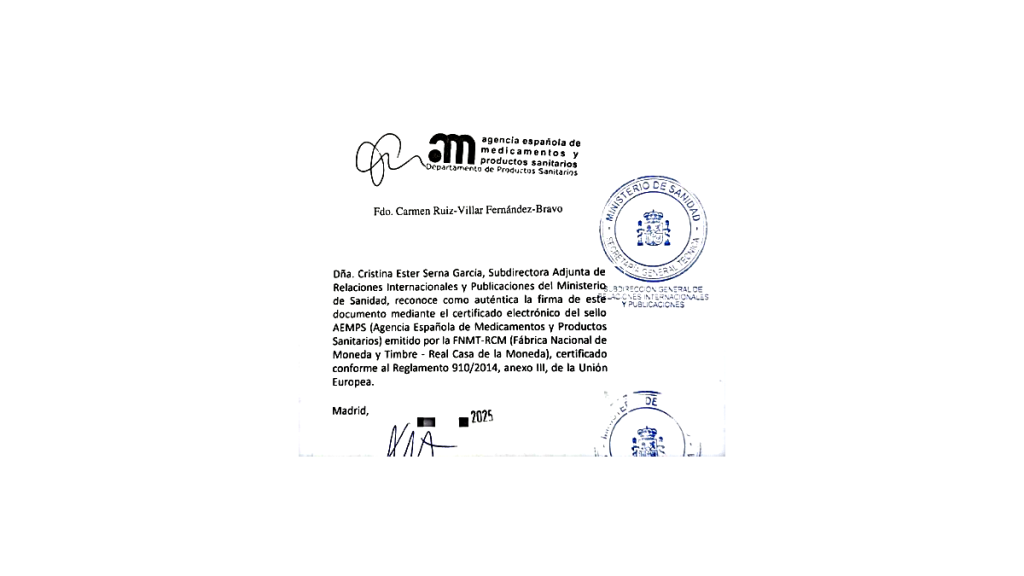
3.3 Legalisation by MAEUEC
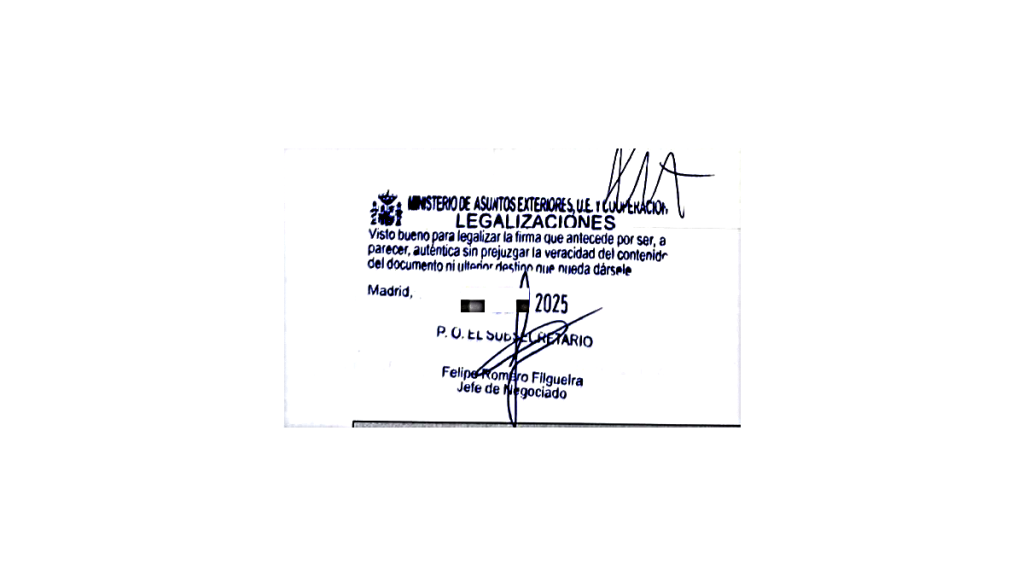
After pre-legalisation, all non-Hague documents must go to the Spanish Ministry of Foreign Affairs (MAEUEC).
Important points to note:
- MAEUEC legalisation is free of charge.
- However, embassy or consular legalisation involves statutory fees.
- Legalisation does not expire, but it does not extend the document’s own validity.
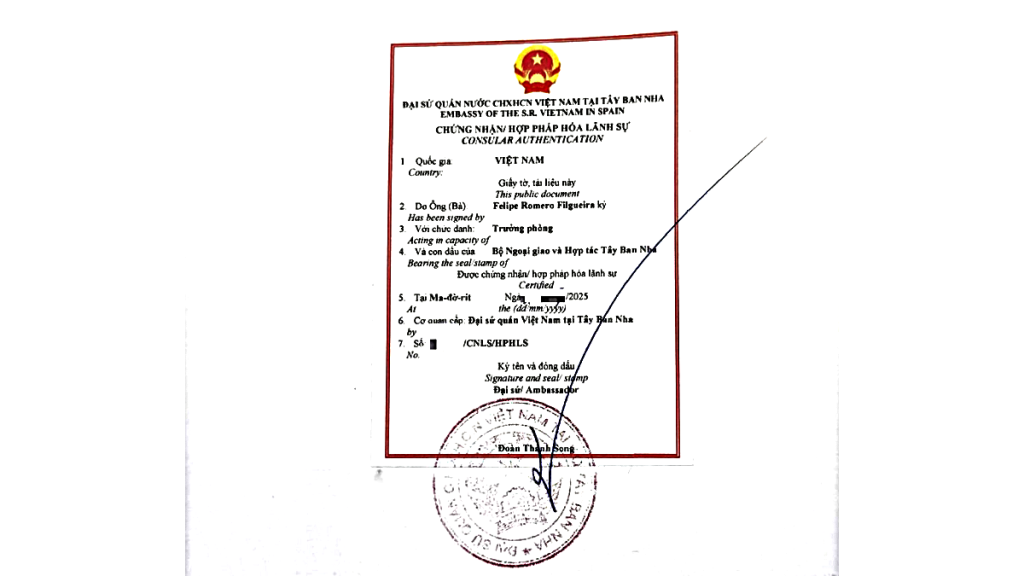
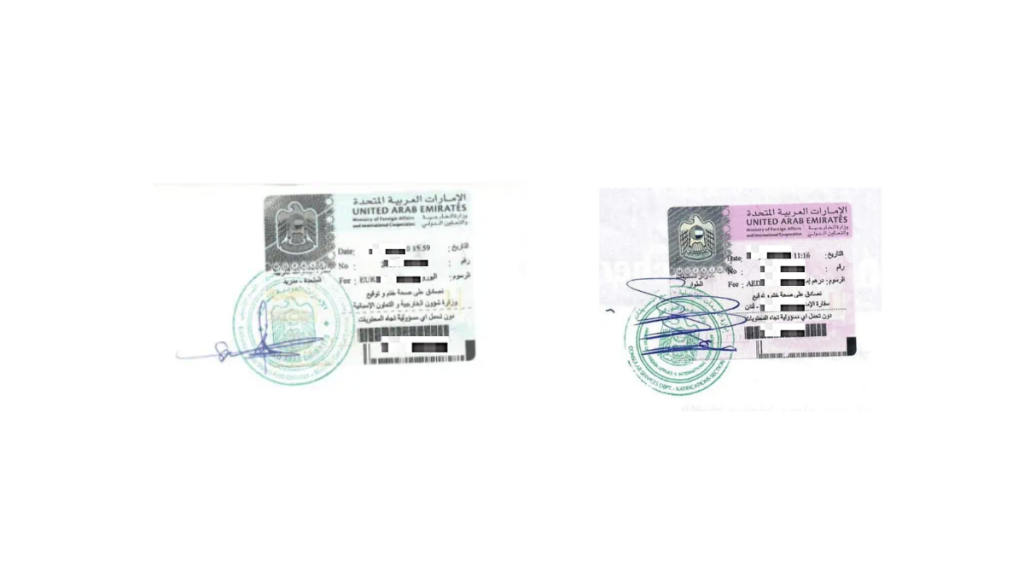
3.4 Legalisation by the Embassy or Consulate
(Embassy Attestation)
After MAEUEC legalisation, most non-Hague countries require embassy or consular legalisation.
At this stage, the embassy confirms that the Spanish Ministry of Foreign Affairs has properly legalised the document. Therefore, this step completes the diplomatic chain.
Embassy legalisation usually takes place at the embassy or consulate of the destination country in Spain, most often in Madrid. However, some countries require submission to a specific consulate.
This step is not free. Fees and processing times vary by country. In addition, many embassies require an official translation into the destination language. For this reason, translation often needs to be completed before embassy submission.
If embassy legalisation is missing or incorrect, the destination country may refuse the document, even if all Spanish steps are complete.
4. Documents That Cannot Be Legalised
Spanish authorities will refuse legalisation in the following cases:
- the document is not a public document,
- the document is a photocopy or laminated copy without proper certification,
- the signature is not handwritten,
- the signatory lacks the required authority,
- the legalisation chain is incomplete,
- the signature is not registered with MAEUEC,
- an official translation is required but missing,
- the document has expired under Spanish law, or
- the document shows alteration or damage.
5. Summary
- Hague Convention countries: Spain apostille only
- Non-Hague countries: Full Spanish legalisation plus embassy or consular legalisation
6. Support with Spain Apostille and Legalisation
Ginkgo Advisory assists with Spain apostille, legalisation, and embassy attestation by coordinating:
- the correct legalisation route,
- authority-specific pre-legalisation,
- MAEUEC submission,
- embassy or consular legalisation, and
- official translations where required.
For document-specific guidance, contact Ginkgo Advisory to ensure your documents follow the correct and accepted legalisation path.
Contact Us



Address
167-169 Great Portland Street, 5/F, London
 English
  Chinese