If you need to use a UK Certificate of Incorporation overseas, understanding whether the receiving country accepts a UK apostille or requires embassy legalisation is essential.
For most international corporate, banking, and regulatory transactions, a UK Certificate of Incorporation must be formally legalised before foreign authorities will accept it.
What Is a UK Certificate of Incorporation?
A UK Certificate of Incorporation is an official company formation document issued by Companies House. It confirms that a company has been legally registered in the United Kingdom and provides key corporate identity details including:
- Company name
- Company registration number
- Date of incorporation
- Jurisdiction of registration
Foreign regulators, banks, investors, and counterparties commonly request a UK Certificate of Incorporation to verify corporate existence and ownership structure.
Typical use cases include:
- Opening overseas corporate bank accounts
- Establishing subsidiaries or special purpose vehicles (SPVs)
- Verifying UK holding company ownership
- Completing cross-border regulatory filings
- Investment and financing transactions
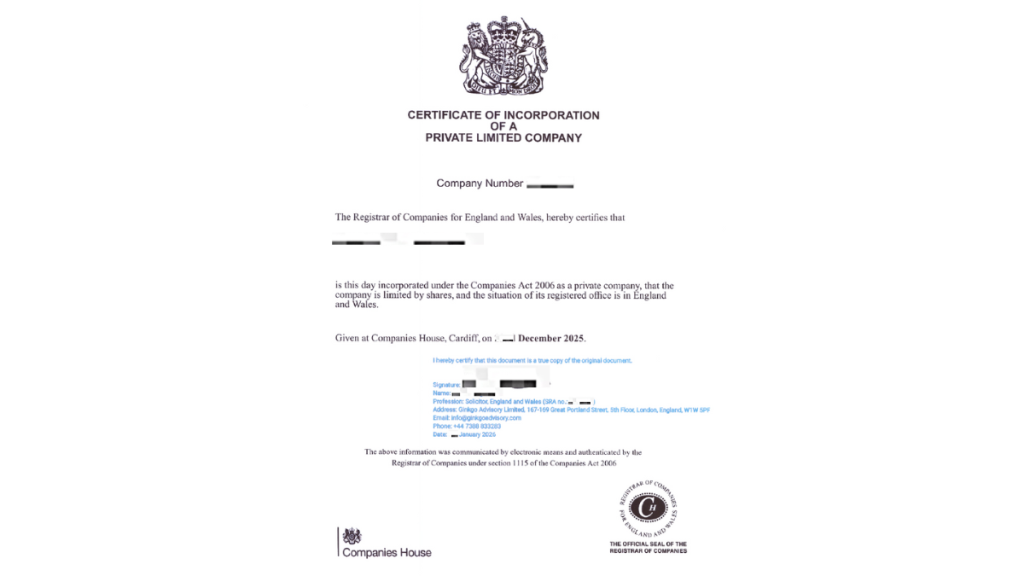
Does a UK Certificate of Incorporation Require an Apostille?
In most cross-border transactions, yes.
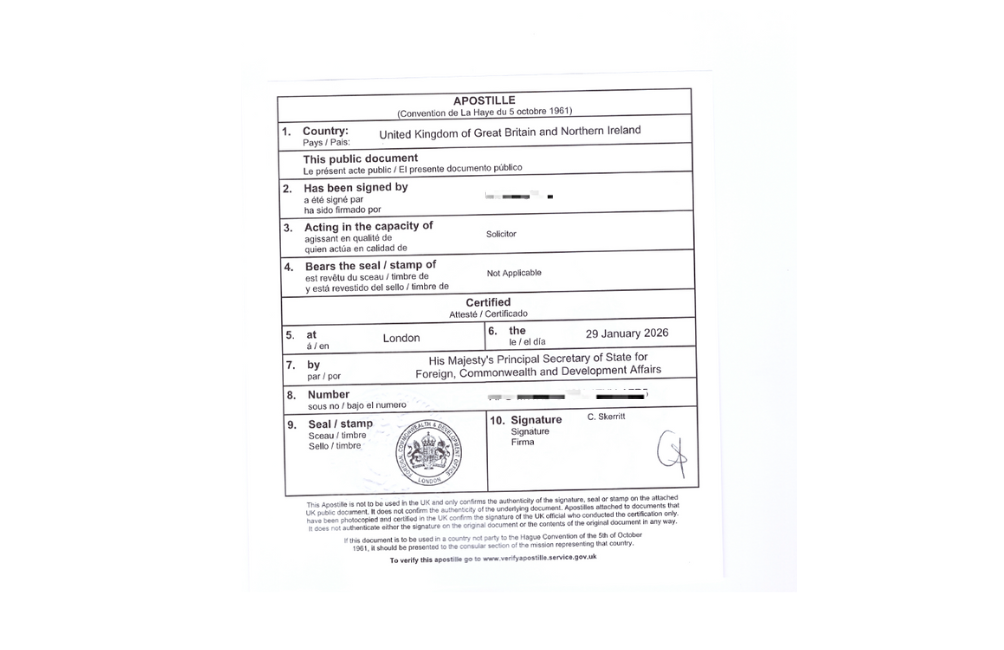
A UK Certificate of Incorporation must usually carry a UK apostille issued by the Foreign, Commonwealth & Development Office (FCDO) before it can be used internationally.
The exact legalisation process depends on whether the receiving country is a member of the Hague Apostille Convention.
Hague Apostille Convention Countries Frequently Used by UK Companies
Many jurisdictions where UK companies hold investments or conduct cross-border operations are Hague Convention members. For these countries, a UK apostille normally completes the legalisation process.
China
China joined the Hague Apostille Convention in November 2023. UK apostilled corporate documents are now widely accepted for:
- Foreign investment registration
- Corporate bank account opening
- Shareholding and beneficial ownership verification
- Corporate regulatory filings and compliance reviews
- Establishment of subsidiaries or representative offices
China is now one of the largest global destinations for UK corporate apostille usage.
Indonesia
Indonesia is a major Southeast Asian investment destination for UK companies, particularly in infrastructure, energy, technology, and manufacturing sectors.
UK apostilled corporate documents are commonly required for:
- Indonesian subsidiary or representative office registration
- Foreign direct investment licensing
- Corporate banking onboarding
- Shareholder and beneficial ownership verification
- Regulatory compliance filings
Indonesia joined the Hague Apostille Convention in 2021, significantly simplifying corporate document legalisation for UK companies.
South Korea
South Korea is a key jurisdiction for UK corporate expansion, technology partnerships, and employment-based corporate structuring.
UK apostilled Certificates of Incorporation are frequently required for:
- Korean corporate entity registration
- Immigration and visa sponsorship structures
- Commercial licensing and regulatory approvals
- Banking and financial compliance onboarding
South Korea accepts UK apostilled corporate documents under Hague Convention procedures.
Non-Hague Convention Countries Requiring Embassy Legalisation in London
Several commercially important jurisdictions where UK companies conduct business have not joined the Hague Convention. For these countries, additional embassy or consulate legalisation is required.
United Arab Emirates (UAE)
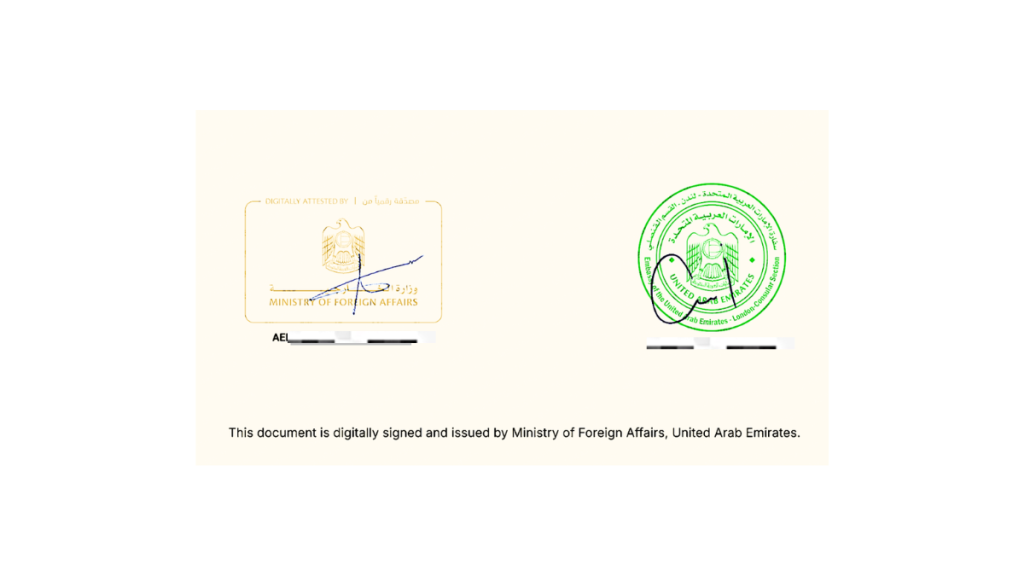
The UAE is widely used for regional headquarters, trading entities, and international holding companies. Corporate documents normally require UAE Embassy legalisation following UK apostille.
Qatar
Qatar frequently requires full embassy legalisation for corporate licensing, government contracts, and commercial registrations involving UK companies.
Kuwait
Kuwait remains a major jurisdiction for energy, infrastructure, and public sector contracting. Corporate documentation typically requires embassy legalisation.
For these countries, legalisation usually follows this sequence:
Solicitor certification → UK apostille → Embassy legalisation in London
Does a UK Certificate of Incorporation Need Solicitor Certification?
Yes.
The FCDO generally does not apostille Companies House documents directly. Instead:
- A UK practising solicitor certifies the document as a Certified True Copy
- The FCDO apostilles the solicitor’s signature and professional capacity
This method is widely accepted by overseas regulators and financial institutions.
How to Apostille a UK Certificate of Incorporation
To prepare a UK Certificate of Incorporation for international use, follow these steps:
Step 1 – Obtain the Certificate
Download or obtain a copy from Companies House or corporate records.
Step 2 – Arrange UK Solicitor Certification
A UK practising solicitor certifies the document as a Certified True Copy of the original Companies House document.
Step 3 – Submit the Document to the FCDO
The Foreign, Commonwealth & Development Office issues the UK apostille certificate confirming the solicitor’s signature and authority.
Step 4 – Arrange Embassy Legalisation (If Required)
This step only applies to non-Hague Convention countries that require additional consular authentication.
Step 5 – Confirm Translation Requirements
Some receiving authorities require certified translations of apostilled documents. Translation requirements vary depending on the jurisdiction and intended use of the document.
Common Legalisation Mistakes to Avoid
Many corporate filings are delayed due to:
- Using uncertified Companies House online copies
- Applying embassy legalisation when apostille alone is sufficient
- Overlooking translation requirements
- Submitting outdated corporate documents
- Incorrect solicitor certification wording
These mistakes frequently lead to rejection by banks, regulators, or counterparties.
Final Takeaway
A UK Certificate of Incorporation requires:
- UK solicitor certified true copy
- UK apostille issued by the FCDO
For Hague Convention countries, this usually completes the legalisation process.
For non-Hague Convention countries, you need embassy legalisation in London after apostille.
UK Certificate of Incorporation Apostille – How Ginkgo Advisory Assists
Ginkgo Advisory coordinates UK corporate document apostille services through UK practising solicitors regulated by the Solicitors Regulation Authority (SRA) and registered with the FCDO.
Our Service Includes
- Solicitor certification of Companies House documents
- FCDO apostille submission and tracking
- Corporate compliance document review
- Cross-border transaction experience
Pricing
From £138 per document
Turnaround
Approximately 3 working days
Contact Us



Address
167-169 Great Portland Street, 5/F, London
 English
  Chinese