Our solicitor can verify, certify, apostille & legalise
Your UK Divorce Final Order / Decree Absolute




About the Author
KH is a practising solicitor based in London, admitted in England & Wales and regulated by the Solicitors Regulation Authority. He is registered with the Foreign, Commonwealth & Development Office. KH has worked as legal counsel and in-house solicitor across leading firms and corporations. He personally oversees every apostille and legalisation case at Ginkgo Advisory, ensuring consistency, accuracy, and end-to-end quality control.
KH Lam, LLB, LLM
Legal Consultant of Ginkgo Advisory
If you need to use a UK Divorce Decree Absolute or Final Order overseas, the process is often more technical than people expect.
Many people assume they can simply print the court PDF and send it for apostille. In practice, that often fails. The safer approach is to review the format of the divorce document first, then choose the right route for solicitor authentication, verification, solicitor certification, FCDO apostille, and embassy legalisation or attestation. That is exactly where Ginkgo Advisory can help.
What is a Decree Absolute or Final Order?
A Decree Absolute is the older term for the document that legally ended a marriage in divorce cases issued before 6 April 2022. A Final Order is the current term used where the court issued the divorce application on or after 6 April 2022. This is the final court document that proves the marriage has legally ended. It is commonly needed for remarriage, immigration, visa, civil status, inheritance, property, and official record purposes overseas.
Why this document often causes apostille problems
This is the part many people miss.
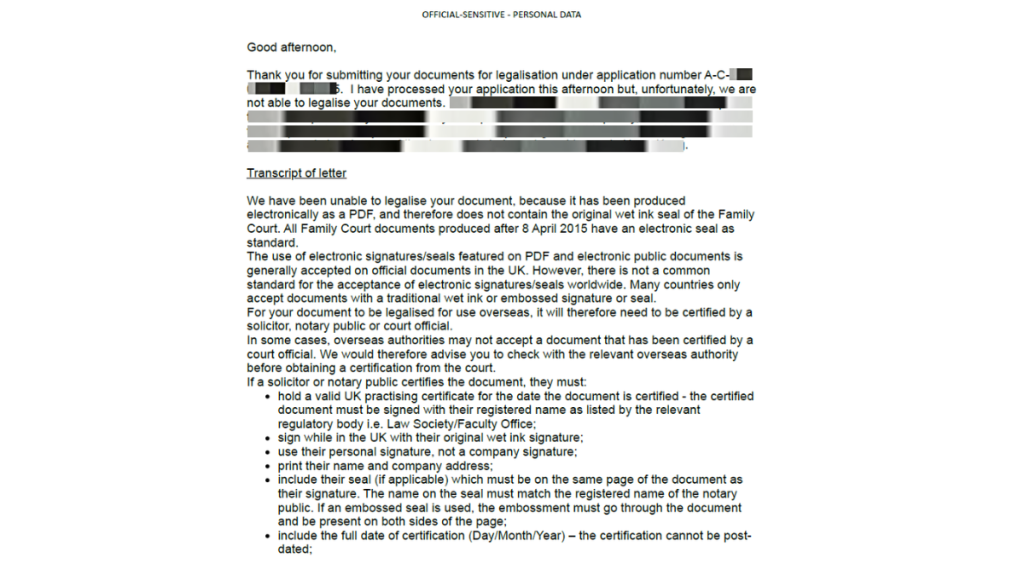
A large number of Family Court divorce documents are now issued as PDFs with electronic seals rather than traditional wet ink seals. The attached FCDO correspondence shows a real example: the Legalisation Office refused to legalise a Family Court PDF because it did not contain an original wet ink court seal. The letter explained that, for overseas use, the document would instead need certification by a solicitor, notary public, or court official, or a fresh version from the court carrying an original wet ink seal.
That is why this is not just a printing exercise. It is a document preparation and authentication issue.
Why solicitor certification wording matters
Many agents and even some solicitors use very basic wording, such as saying the document is a printout presented to them. That is often the weakest version of certification.
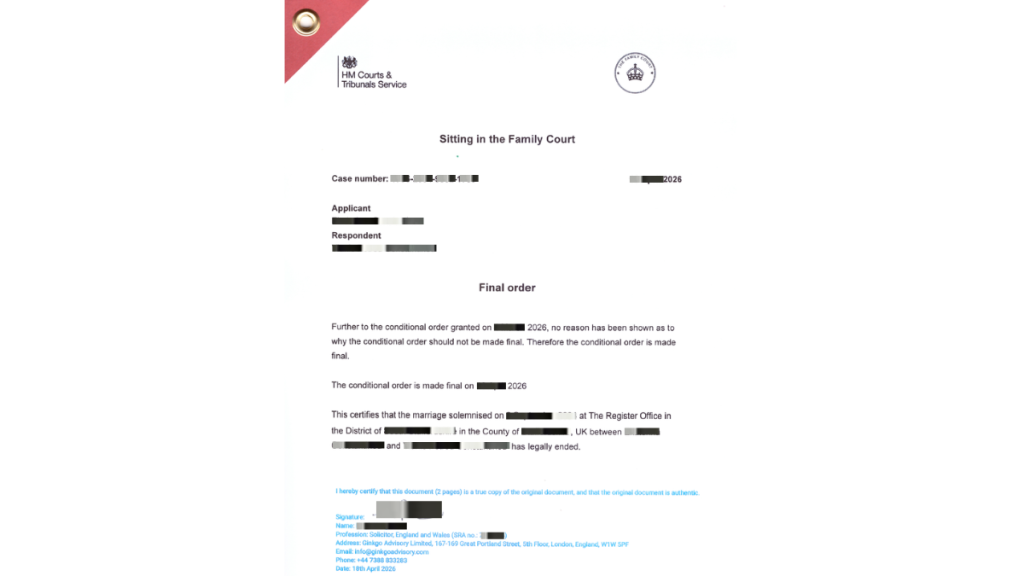
At Ginkgo Advisory, we take a stronger approach where appropriate. We do not rely only on a minimal “certified true copy” formula. We focus on verification and authenticity trail building first, then prepare solicitor certification that better explains what has been checked, what the document is, and how it links back to the original electronic court document or source material.
This approach is especially helpful when the receiving authority wants more than a bare copy statement, or when the document is going abroad for a high-stakes use such as marriage registration, immigration, residency, or official civil status recognition.
Our usual workflow
1. Review the divorce document
We first check what you have.
Is it:
- a court-issued PDF Final Order or Decree Absolute
- a paper court document
- a replacement court copy
- a document that may need to be re-obtained from the court first
This first step matters because the best legalisation route depends on the document format.
2. Verification and solicitor authentication
We then review the source, the issuing details, and the supporting material behind the document.
This is where our work is different from firms that simply certify a printout placed in front of them. We look at the document logic, the source chain, and the authenticity position before certification.
3. Solicitor certification
Once the document is ready, we prepare solicitor certification in the correct form for the next stage.
If a solicitor or notary certifies the document, they must hold a valid practising certificate, sign in the UK with an original wet ink signature, use their personal signature, print their name and address, date the certification properly, and clearly state the action taken. It also explains that, where a cover sheet is used, it must be securely attached and specifically refer to the attached document.
4. FCDO Apostille
After certification, we can arrange UK apostille.
We can also offer a 2 working day UK apostille service in suitable cases.
5. Embassy legalisation or attestation
If the destination country requires more than apostille alone, we can also arrange embassy legalisation, consular attestation, or the relevant final step after apostille.
This is often needed where the receiving country has its own embassy or consular document legalisation requirements.
How Ginkgo Advisory can help
At Ginkgo Advisory, we help clients with the full process from start to finish:
- review of the divorce document format
- verification and authenticity-based assessment
- solicitor authentication
- solicitor certification
- 2 working day UK apostille in suitable cases
- embassy legalisation or attestation where required
Our approach is designed for clients who want a stronger and more credible document trail for overseas use.
We are not trying to do the bare minimum. We aim to prepare the document properly, reduce avoidable rejection risk, and build a certification package that makes practical sense for real international use.
When you should get advice before you apply
You should get the document checked before applying if:
- your Final Order or Decree Absolute is only available as a PDF
- the receiving country is strict about originals, wet ink signatures, or court seals
- you need the document for remarriage, immigration, or official registration
- you are not sure whether the destination authority will accept a paper apostille or e-Apostille
- you want more than a weak printout certification
A short review at the start can prevent delay, rejection, and repeat cost later.
A better route for overseas use
A UK Divorce Decree Absolute or Final Order is a straightforward document in domestic use, but overseas use is often more technical.
The safest route is usually:
document review → verification → solicitor authentication → solicitor certification → FCDO apostille → embassy legalisation or attestation if needed
That is the workflow Ginkgo Advisory can arrange for you.
If you need to legalise a UK Divorce Decree Absolute or Final Order for use abroad, we can help you prepare it properly from the start.
Contact Us



Address
Suite 161, 30 Red Lion Street, Richmond, London