Our solicitor can verify, certify, apostille & legalise
All UK recognised degree-awarding universities or colleges
471
recognised UK
institutions



About the Author
KH is a practising solicitor based in London, admitted in England & Wales and regulated by the Solicitors Regulation Authority. He is registered with the Foreign, Commonwealth & Development Office. KH has worked as legal counsel and in-house solicitor across leading firms and corporations. He personally oversees every apostille and legalisation case at Ginkgo Advisory, ensuring consistency, accuracy, and end-to-end quality control.
KH Lam, LLB, LLM
Legal Consultant of Ginkgo Advisory
If you are a UK citizen planning to teach English in South Korea, your school or recruiter will usually require two UK documents in a specific legal format:
- a UK criminal record certificate (most commonly a DBS certificate)
- a certified copy of your university degree certificate
In practice, most delays do not happen because an applicant is ineligible. Instead, they happen because documents are prepared in the wrong order, certified incorrectly, or apostilled too early.
This guide explains how UK documents must be prepared for Korea’s E-2 visa process, and how solicitor certification and the Foreign, Commonwealth & Development Office (FCDO) apostille should be handled so documents are accepted the first time.
Where UK documents fit in the E-2 visa process
Before looking at individual documents, it helps to understand where they sit in the overall E-2 workflow.
In most cases, the process works like this:
First, you prepare your UK documents and send them to your school or recruiter.
Next, the school submits those documents to Korean immigration as part of the Visa Issuance Number (VIN) application.
After that, once a Visa Issuance Number is issued, you submit your visa application through the required channel for your region.
Finally, after you enter Korea, you complete the post-arrival steps required to live and work legally.
Because immigration reviews your documents at the Visa Issuance Number stage, any error at this point can delay the entire process. For this reason, correct preparation matters far more than speed.
The two UK documents that cause most problems
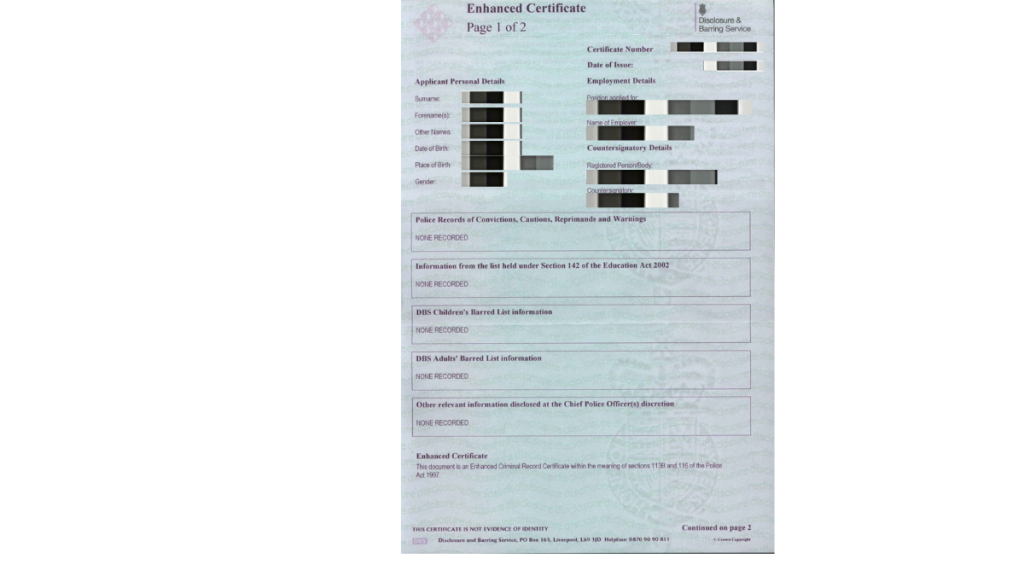
UK criminal record certificate (DBS)
Most recruiters ask for a UK nationwide criminal record certificate. In many cases, this is a DBS certificate.
For Korea, three points usually matter.
First, timing matters. The certificate normally needs to be issued within a recent window, often six months, when it reaches immigration.
Second, the certificate must be apostilled for overseas use.
Third, if the DBS is not issued in a form that can be apostilled directly, it must be certified by a UK solicitor before the apostille is applied.
This third point causes the most confusion. Many applicants assume they can send any DBS straight for apostille. However, when the certificate does not carry an apostille-eligible signature, solicitor certification becomes a required legal step.
Because requirements can vary by employer, you should always confirm whether your school wants a DBS or another UK criminal record certificate before ordering one.
University degree certificate
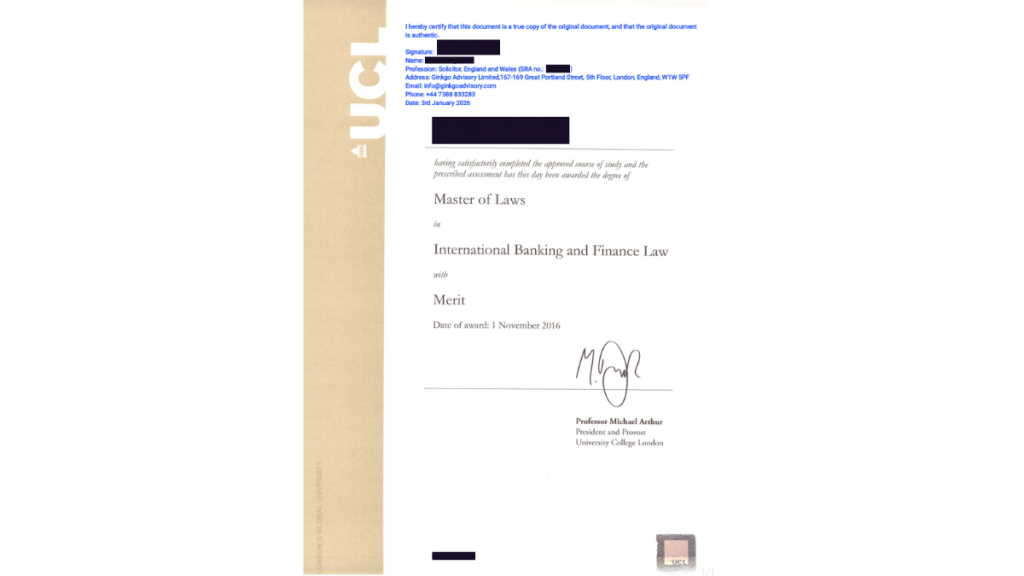
Korean immigration does not usually accept original degree certificates sent overseas. Instead, recruiters normally request a certified copy.
In practical terms, this means:
- you provide a copy of your degree certificate
- a UK solicitor certifies the copy as a true copy of the original after verification
- the certified copy is then apostilled by the FCDO
If any of these steps are missing or completed in the wrong order, the document may be rejected, even though the degree itself is valid.
The correct legal order (critical)
Many applicants focus on getting an apostille as quickly as possible. However, applying an apostille too early is one of the most common mistakes.
For Korea E-2 documents, the safe legal order is:
First, confirm that you have the correct document and that it meets the timing requirements.
Next, complete solicitor certification or notarisation where required.
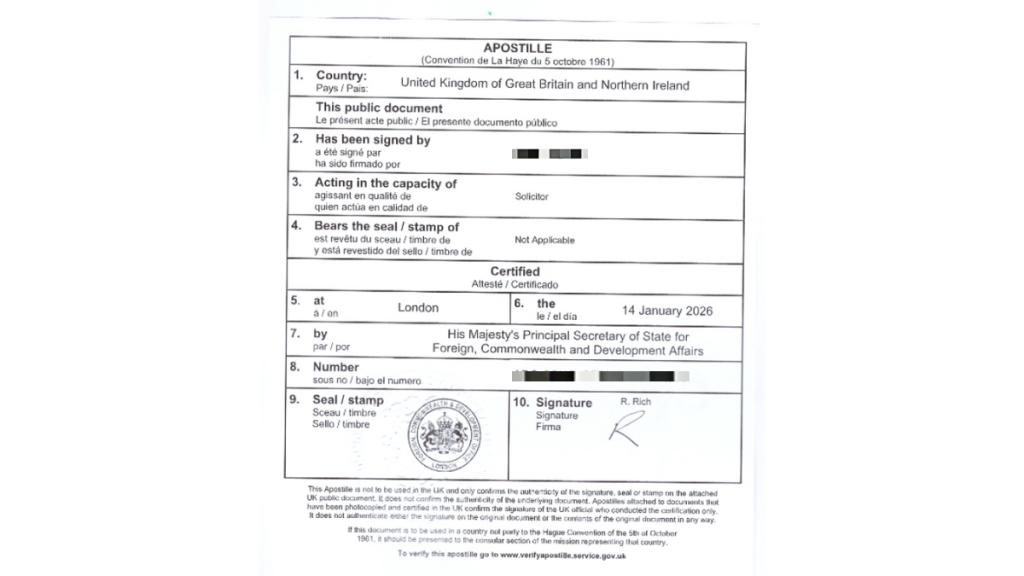
Only after that should the document be submitted for an FCDO apostille.
This order matters because an apostille does not confirm document content. Instead, it confirms the authority of the person who certified it. Therefore, certification must always come first.
Why a practising UK solicitor matters
Not every signature is acceptable for apostille purposes.
When a DBS certificate or degree copy needs certification, the certifier must be someone whose signature the FCDO can verify. In practice, this means a UK-qualified solicitor with a valid practising certificate.
If the certification wording is unclear, informal, or completed by an unauthorised person, the apostille may be refused or later rejected by Korean immigration. As a result, choosing the correct certifier is not a formality. It is a structural requirement.
How our service supports E-2 applicants
Our service focuses on preparing UK documents so they are accepted by Korean immigration without unnecessary back-and-forth.
We assist with:
- reviewing your DBS and degree documents before certification
- verifying and certifying DBS certificates where certification is required
- verifying and certifying university degree certificates as true copies
- arranging certification by a UK practising solicitor
- submitting documents to the FCDO for apostille and return
Because timing and order matter, we also help applicants avoid documents expiring or being apostilled at the wrong stage.
TEFL, CELTA and TESOL certificates
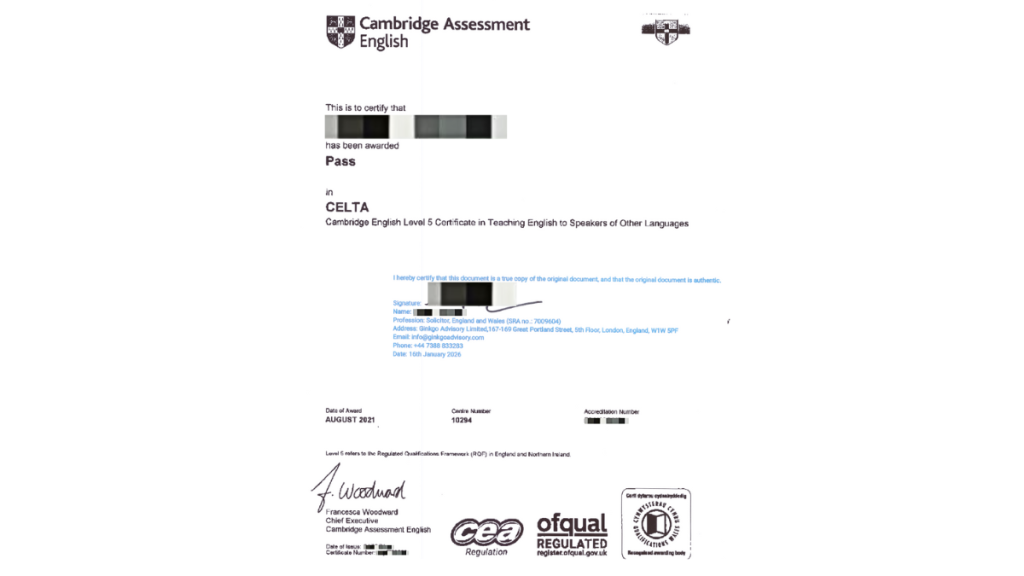
Some schools also ask for TEFL, CELTA or TESOL certificates. Whether these are required depends on the employer, rather than immigration itself.
If a recruiter requests these certificates, the same principles apply. You should confirm the requirement first, then complete certification before apostille. Preparing optional documents incorrectly can still delay the overall visa process.
Summary
For most UK citizens applying for an E-2 visa to teach English in South Korea, successful document preparation depends on structure rather than guesswork.
In most cases, you will need:
- a valid UK criminal record certificate prepared in the correct format
- a solicitor-certified copy of your university degree certificate
- an FCDO apostille applied after certification
Most problems arise because certification is missing, the apostille is applied too early, or the document order is wrong.
Handled correctly, UK documents are routinely accepted by Korean immigration.
Contact Us



Address
Suite 161, 30 Red Lion Street, London, TW9 1RB, England