Our solicitor can verify, certify, apostille & legalise
All UK recognised degree-awarding universities or colleges
471
recognised UK
institutions



About the Author
Kwok is a practising solicitor based in London, admitted in England & Wales and regulated by the Solicitors Regulation Authority. He is registered with the Foreign, Commonwealth & Development Office. Kwok has worked as legal counsel and in-house solicitor across leading firms and corporations. He personally oversees every apostille and legalisation case at Ginkgo Advisory, ensuring consistency, accuracy, and end-to-end quality control.
Kwok Lam
Legal Consultant of Ginkgo Advisory
If you plan to teach English overseas using a CELTA certificate, most immigration authorities and employers will require your qualification to be formally legalised.
Common destinations requiring legalised CELTA documents include:
- China
- South Korea
- Vietnam
- Thailand
- Many Middle East and Asia TEFL destinations
This guide explains the correct UK legalisation route for CELTA certificates, with a particular focus on fully remote processing, including:
- Cambridge English authenticity verification
- UK solicitor certification
- UK FCDO apostille
- Embassy legalisation (where required)
The goal is simple: help applicants avoid rejection, delay, and unnecessary travel.
Why CELTA Certificates Often Get Rejected Overseas
In professional UK legalisation cases, most rejections happen not because applicants lack qualifications, but because documents are prepared incorrectly.
Common issues include:
- Submitting uncertified copies
- Using low-level certification wording
- Skipping authenticity verification
- Using solicitors not recognised by the FCDO
- Completing legalisation steps in the wrong order
Following the correct structure significantly improves approval success rates.
Remote CELTA Legalisation — The Modern Standard
Most applicants now complete the entire UK legalisation process remotely.
In many cases, the process can begin using only:
- A clear scanned copy of your CELTA certificate
- Basic identification documents
Verification coordination, solicitor certification preparation, apostille submission, and embassy legalisation can usually be arranged without requiring you to attend in person.
Original documents, if required, can normally be handled later via secure international courier.
Who Issues UK Apostilles?
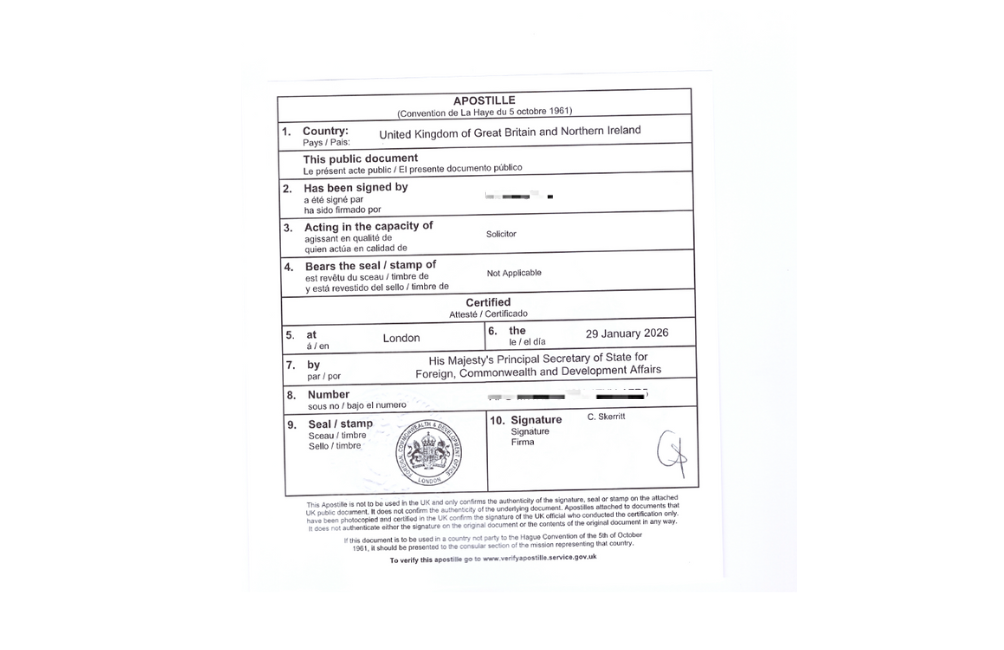
UK apostilles are issued by the Foreign, Commonwealth & Development Office (FCDO).
The FCDO will only apostille documents that have been properly certified by an authorised professional. Accepted certifiers include:
- Practising UK solicitors
- UK notary publics
Many applicants choose solicitor certification because:
- Costs are usually lower than notary services
- Processing is often faster
- Remote handling is typically easier
Step 1 — Cambridge English CELTA Authenticity Verification
Before certification, authenticity verification is strongly recommended.
CELTA certificates are issued by Cambridge English, which requires manual verification confirmation before higher-level certification wording can be issued.
Verification confirms:
- Certificate authenticity
- Candidate details
- Valid issuance record
Typical verification timeline
3-5 working days.
With authenticity verification, solicitor certification can proceed using stronger legal wording. This significantly reduces rejection risk in visa and work permit applications.
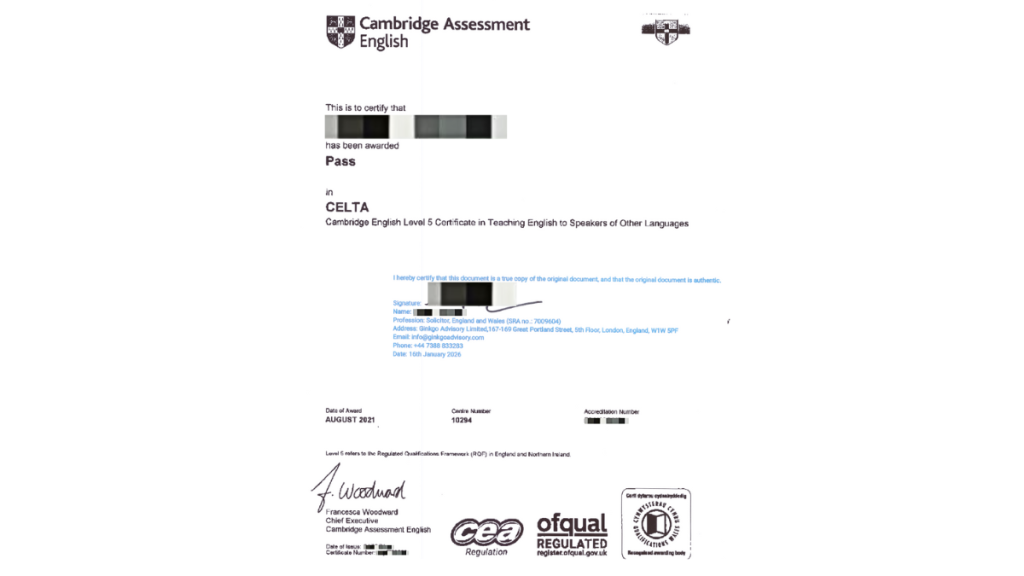
Step 2 — UK Solicitor Certification of CELTA Certificate
After verification, a practising UK solicitor certifies the CELTA certificate copy.
There are two common certification approaches:
Basic Certification
Confirms the copy matches the original document.
Enhanced Certification (Recommended)
The practising UK solicitor should confirm and verify authenticity with Cambridge English.
Enhanced certification is often necessary in:
- China
- South Korea
- Vietnam
- Thailand
Solicitor enhanced certification is particularly suitable for remote applicants because certification arrangements and document preparation can usually be coordinated digitally before any courier is arranged.
Step 3 — UK FCDO Apostille
After certification, the solicitor-certified copy can be submitted to the UK FCDO for apostille.
Official FCDO legalisation portal:
https://www.gov.uk/get-document-legalised
Important requirement:
The certifying solicitor must be recognised by the FCDO. If not, the apostille application may be rejected.
Typical timelines
Standard route:
- Approximately 15 working days
- Plus courier time
Professional submission:
- Often reduced to a few working days
FCDO apostille submissions can normally be handled entirely through UK professional representatives, allowing overseas applicants to complete the process remotely.
Step 4 — Embassy Legalisation (Country-Specific)
Some countries accept UK apostilles directly. Others require embassy legalisation after the FCDO apostille.
Vietnam
Vietnam typically requires Vietnamese Embassy legalisation after FCDO apostille.
Typical processing time: approximately 5 working days.
China
Since November 2023, most UK public documents can normally be used directly after UK apostille without embassy legalisation.
South Korea
South Korea generally accepts UK apostille documents without an embassy legalisation stage.
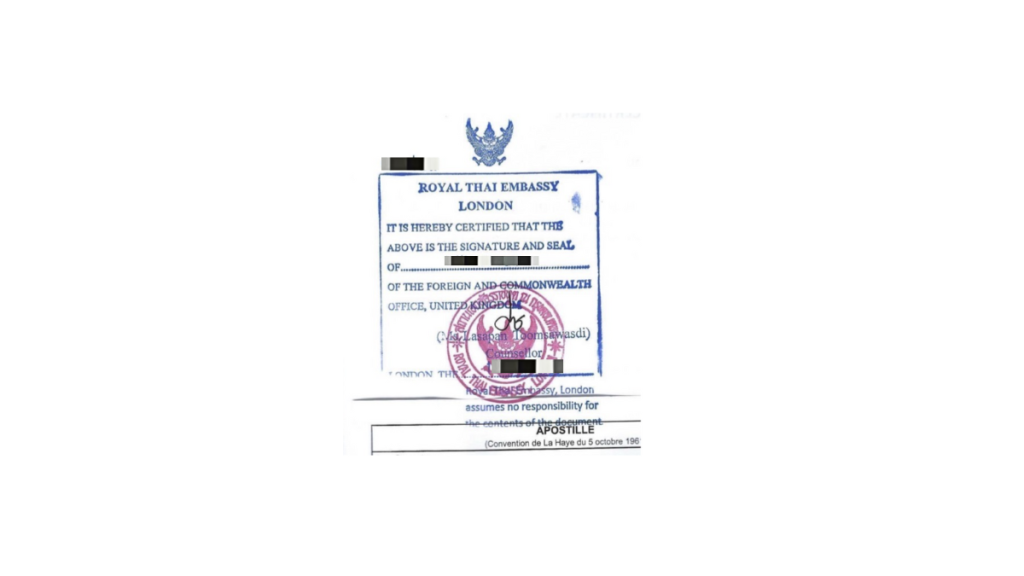
Thailand
Thailand typically requires embassy attestation at the Royal Thai Embassy in London after FCDO apostille.
Typical processing time: approximately 3–4 working days.
Correct Legalisation Order (Critical)
The correct sequence is:
Cambridge English Verification → Solicitor Certification → UK Apostille → Embassy Legalisation (if required)
Completing steps in the wrong order is one of the most common causes of rejection.
Fully Remote CELTA Legalisation Workflow
In most cases, we can complete your entire legalisation process remotely.
Typical remote workflow includes:
- Submit scanned CELTA certificate copy
- Coordinate Cambridge English authenticity verification
- Arrange UK solicitor certification
- Submit document for FCDO apostille
- Complete embassy legalisation (if required)
- Return documents via international courier
This structure allows applicants to complete legalisation without travelling to the UK.
How Ginkgo Advisory Can Help
Ginkgo Advisory Limited specialises in UK cross-border document legalisation, particularly for academic qualifications and employment-related documentation.
We assist applicants worldwide who need to prepare UK documents for overseas immigration, employment, and regulatory use.
Our support typically includes:
Legalisation Structure Planning
We review your destination country requirements and confirm the correct legalisation route before processing documents. This helps reduce rejection risk and avoids unnecessary certification steps.
Cambridge English Verification Coordination
We assist with CELTA authenticity verification requests and monitor verification confirmation before certification proceeds.
UK Solicitor Certification
A UK practising solicitor experienced in preparing documents suitable for FCDO apostille submission will complete your certification.
FCDO Apostille Handling
We prepare and submit documents through recognised FCDO submission channels and monitor processing status.
Embassy Legalisation Coordination
Where required, we arrange embassy legalisation in London, including Vietnam and Thailand embassy attestation processes.
Fully Remote Processing
Most clients complete the entire legalisation process remotely. In many cases, the process begins with scanned documents, with courier arrangements handled later.
Multi-Country Experience
We regularly assist clients preparing CELTA certificates and academic documents for use in:
China
South Korea
Vietnam
Thailand
Middle East employment visas
International teaching placements
Our Typical Processing Timeline (Full UK Route)
Cambridge verification: 2–3 working days
Solicitor certification: usually 1 working day
FCDO apostille: 2-3 working days
Embassy legalisation (if required): 3–5 working days
Estimated total timeframe:
Approximately 2 weeks depending on destination country and processing route.
Countries That Commonly Require CELTA Legalisation
Applicants frequently require legalisation when teaching in:
China
South Korea
Vietnam
Thailand
United Arab Emirates
Qatar
Saudi Arabia
Japan
Taiwan
Final Summary — CELTA Legalisation Requirements
To legally use a CELTA certificate overseas, most applicants will require:
- Cambridge English authenticity verification
- UK solicitor certification
- UK FCDO apostille
- Embassy legalisation (country dependent)
Following the correct sequence significantly reduces rejection risk and speeds up visa or work permit approval.
Most applicants can now complete the entire process remotely using professional UK legalisation support.
Contact Us



Address
167-169 Great Portland Street, 5/F, London